
Four issues a year, free to read, since 2012
Network Law Review
The complex science of markets & digital laws
Article
Waiting Behind the Platform: Why Competition Law Should Measure Innovation Access Lag
- a PhD Candidate, Vrije Universiteit Amsterdam
Article info
- Published
- 25 November 2026
- Issue
- Fall 2026, pages 72–84
- Cite as
- Mirza, G. (2026, Fall). Waiting behind the platform: Why competition law should measure innovation access lag. Network Law Review, 72–84. https://
www .networklawreview .org/ innovation-access-lag/
Abstract
Competition law asks whether rivals receive access to the technologies a platform controls, but it rarely asks where they stand in the sequence in which those technologies become available. The firm governing a platform decides who receives each innovation first and how long others wait. This contribution calls that wait the innovation access lag. The law has no systematic way to observe this lag, which makes it harder to tell a legitimate wait from an exclusionary one. This contribution proposes measuring the innovation access lag relative to the firms that already have access, so that it can serve as evidence in the assessment of effects, justification and remedies.1 I am indebted to Thibault Schrepel for comments on an earlier draft.
1. Introduction
In 2011, a Google executive set out in an internal email what would happen to manufacturers that sold incompatible versions of Android. Partners that did not meet their obligations would be cut off, with “no GMS, no early access, no technical support – nothing.”2 Commission Decision of July 18, 2018, Case AT.40099, Google Android, ¶ 1057 & n.1128; see also id. ¶ 1064. Early access to the next version of Android was among the things Google could give and withdraw. Google released the source code of each version only after launching a flagship device developed with a manufacturer of its choice, and it could delay the release further.3 Id. ¶ 128.
The advantage at stake is time. The firm that develops a new version necessarily has it before anyone else, and that lead from development is not the concern here. This contribution is concerned with what follows, in which rivals wait for access once the owner’s own services or its favoured partners already have it. It calls this innovation access lag. Some of that wait may be needed to finish or secure access, but whether it is justified is a separate question from how long it is. The lag ends when the rival receives access it can build on. The further time a rival needs to turn that access into a product is not part of the lag, although it can add to the disadvantage the lag causes. The rivals concerned differ. Developers of rival versions of a platform, manufacturers outside an early-access programme, and developers of apps or devices that compete with the owner’s own products all wait for different things, and a measure would differ for each.
Competition law repeatedly meets questions of access timing, but it has neglected differential access. It treats access mainly as a question of whether rivals receive it, not of when they receive it relative to others, and it does not measure the lag systematically. Section 2 sets out what management research shows about why the lag matters, and why it remains unmeasured. Section 3 examines how competition law deals with access timing and shows why it leaves the innovation access lag unmeasured. Section 4 sets out how the lag should be measured and how it informs the assessment of effects, justification and remedies. The contribution does not propose a general metric but offers an illustration of how the innovation access lag could be measured. It argues that the lag should be measured, because the law already asks questions that it would help answer, and it states the principles a measure should follow.
2. Why Access Lag Matters
Innovation access lag has several dimensions. The most obvious is how long rivals wait for a new version or feature. Other dimensions include: who is admitted to early access and on what terms, whether innovation reaches rivals continuously or in occasional bulk releases, and how much notice precedes the changes that rivals must absorb. The lag is distinct from openness, since a platform published under a fully open licence can still reach rivals late. It is also distinct from cadence, which counts how often an ecosystem receives new versions.
Management research documents the mechanisms through which the lag would matter. When Google’s threat to enter an Android app category increased, developers of the affected apps reduced their innovation on those apps and shifted it to others.4 Wen Wen & Feng Zhu, Threat of Platform-Owner Entry and Complementor Responses: Evidence from the Mobile App Market, 40 Strategic Mgmt. J. 1336, 1337–38 (2019). Platform owners also have near-complete information about complementors’ products, including the nature of their upgrades, and their entry affects third-party developers most where the owner’s offering is integrated into the operating system.5 Aldona Kapacinskaite & Ahmadreza Mostajabi, Competing with the Platform: Complementor Positioning and Cross-Platform Response to Entry, 45 Strategic Mgmt. J. 2577, 2579 (2024); Benjamin T. Leyden, Sherlocking: The Effects of Platform-Owner Entry on the Competitive Behavior of Third-Party Firms 5, 30 (Working Paper, Jan. 16, 2026), https://kgi.georgetown.edu/wp-content/uploads/2026/01/Sherlocking_Leyden_73.pdf. These studies show that the owner’s position next to its complementors shapes where they innovate, and early access is one way of strengthening that position.
Timing matters to how complementors fare. The performance of iOS apps built on new platform features depends on when they are released relative to the adoption of each platform generation.6 Franck Soh & Varun Grover, Effect of Release Timing of App Innovations Based on Mobile Platform Innovations, 37 J. Mgmt. Info. Sys. 957, 957–58 (2020). Economic modelling of exclusion in network markets finds that conduct is most effective when applied early, before a rival has built a user base.7 Oliver Latham & Chara Tzanetaki, R You Being Foreclosed?, 18 Eur. Competition J. 328, 330 (2022). Information systems research treats a platform’s release strategy as a governance practice that shapes how quickly complementors update their products.8 Dan Luo, Yulin Fang, Peijian Song & Chong (Alex) Wang, The Impact of Digital Platform Rapid Release Strategy on App Update Behavior: An Empirical Study of Firefox, in Proceedings of the 40th International Conference on Information Systems 1 (2019), https://aisel.aisnet.org/icis2019/is_heart_of_innovation_ecosystems/innovation_ecosystems/7. Together these findings point to a mechanism rather than a measured effect. Earlier access lets the firms that receive it enter, learn and gather users sooner, and in markets with network effects those advantages can outlast the wait that produced them.
The advantage the lag confers can be more than a transient head start. Courts have often treated a dominant firm’s lead in complementary products as only a head start, which rivals could close by reverse engineering. Van Arsdale and Venzke argue that in software markets, where network effects are strong and access can be blocked outright, the harm is more than a mere head start.9 Suzanne Van Arsdale & Cody Venzke, Predatory Innovation in Software Markets, 29 Harv. J.L. & Tech. 243, 272, 278 (2015). Innovation access lag can be a lead of this kind, conferred not by better engineering but by control over when rivals may begin.
Neither the literature nor legal practice offers a systematic, comparable way to measure the lag. The nearest measurements concern other things. Software engineering research has measured how long Android apps take to adopt new interfaces after their public release.10 Tyler McDonnell, Baishakhi Ray & Miryung Kim, An Empirical Study of API Stability and Adoption in the Android Ecosystem, in Proceedings of the 2013 IEEE International Conference on Software Maintenance (2013). That measures how quickly developers catch up once a release is public, not how long they wait before it. Economic work on interoperability degradation models how far a dominant firm lowers the quality of rivals’ interoperability, not when rivals receive it.11 Christos Genakos, Kai-Uwe Kühn & John Van Reenen, Leveraging Monopoly Power by Degrading Interoperability: Theory and Evidence from Computer Markets, 85 Economica 873 (2018) (accepted manuscript at 5), https://www.repository.cam.ac.uk/items/0d24d9a6-f2a1-4e47-b5cf-6171a240e0f6. No source reviewed, in competition law, economics or management, proposes a measure of the gap between the platform owner’s access and that of its rivals.12 The closest work identifies the problem without measuring it. See Van Arsdale & Venzke, supra note 9, at 272; Giuseppe Colangelo & Alba Ribera Martínez, The Metrics of the DMA’s Success, 16 Eur. J. Risk Reg. 1017, 1033 (2025). On the related strategy of opening a platform early and closing it later, see Friso Bostoen, The General Court’s Google Shopping Judgment: Finetuning the Legal Qualifications and Tests for Platform Abuse, 13 J. Eur. Competition L. & Prac. 75, 83 (2022); Friso Bostoen & Nicolas Petit, Antitrust Rules and Remedies Against Platforms’ Treacherous Turns, 30 Eur. L.J. 629, 629 (2024).
3. Where Competition Law Meets Access Timing
Competition law has faced questions related to access timing in remedies, in commitments and in traditional refusal-of-access cases under Article 102. It increasingly meets similar questions in the DMA and in new cases concerning access to ecosystems and self-preferencing. In these cases, competition law only measures whether a firm has complied with an obligation the law sets. That leaves important gaps in what the law can see of the innovation access lag.
3.1 Remedies and Commitments
In cases involving remedies or commitments, deadlines may be set for firms to offer access to an input, or a platform, or to ensure interoperability with them. Those deadlines are fixed once in the decision to impose or accept the remedy or commitment. That is the moment when the Commission assesses the effectiveness of the obligations imposed and determines ex ante the acceptable wait that third parties may face. Afterwards the Commission checks only whether the firm has met the deadline. A firm that is one day late is in breach, and so is a firm that is a year late. Which of these breaches is punished and how is an enforcement choice. In neither case does the Commission ask afresh whether the breach causing delayed access harmed rivals.
Competition law first met such questions at the remedy stage, by setting deadlines for access. In 1984, IBM undertook to disclose software interface information once it had become reasonably stable and hardware interface information at the earlier of general availability or 120 days from announcement. Early access for a few customers selected for testing did not start the clock.13 IBM Undertaking, Bull. EC 10-1984, pts. 3.4.1–3.4.2, at 96–103, ¶¶ 4, 20(a), app. A (undertaking of Aug. 1, 1984), https://www.cptech.org/at/ibm/ibm1984ec.html. In Microsoft, the Commission required that the interoperability information be kept up to date.14 Commission Decision 2007/53/EC of Mar. 24, 2004, Case COMP/C-3/37.792, Microsoft, C(2004) 900 final, art. 5(b), 2007 O.J. (L 32) 23. The US judgment required Microsoft to disclose the Windows interfaces its middleware used by the last major beta release.15 United States v. Microsoft Corp., No. 98-1232 (CKK), Second Modified Final Judgment §§ III.D, VI (D.D.C. Nov. 12, 2002, as modified Sept. 7, 2006) (definition of “Timely Manner”).
These deadlines were negotiated. They were neither set nor enforced by reference to how long rivals waited or how harmful their wait was. Critics argued Microsoft controlled its own beta schedule and could release the last beta just before the final product.16 Public Comment MTC-00002572, United States v. Microsoft Corp., No. 98-1232 (CKK) (D.D.C. 2002), https://www.justice.gov/atr/cases/ms_tuncom/major/mtc-00002572.htm. In Europe, Microsoft remained in breach of its disclosure obligations until October 2007, more than three and a half years after the 2004 decision. The Commission imposed penalty payments but framed Microsoft’s failures as incomplete documentation and unreasonable remuneration, not as delay that harms innovation.17 Commission Decision of July 12, 2006, Case COMP/C-3/37.792, Microsoft (fixing the definitive amount of the periodic penalty payment), ¶¶ 142, 148, https://ec.europa.eu/competition/antitrust/cases/dec_docs/37792/37792_2186_8.pdf; Summary of Commission Decision of Feb. 27, 2008, Case COMP/C-3/37.792, Microsoft, C(2008) 764 final, ¶¶ 4–6, 14, 22–26, 2009 O.J. (C 166) 20.
3.2 The DMA’s Parity Obligations
The Digital Markets Act (DMA) addresses access timing by rule. Article 6(7) requires a gatekeeper to give third parties effective interoperability with the same hardware and software features as are available to its own services.18 Regulation 2022/1925, of the European Parliament and of the Council of 14 September 2022 on Contestable and Fair Markets in the Digital Sector and Amending Directives (EU) 2019/1937 and (EU) 2020/1828 (Digital Markets Act), art. 6(7), 2022 O.J. (L 265) 1. The Commission checks whether the gatekeeper met this obligation, and an ongoing delay in providing access may amount to a failure of compliance. Because the DMA is ex ante regulation, its obligations apply without proof of effects in each case, so it does not need to ask whether a wait harmed rivals. It may equally punish harmless and harmful delays. This setup leaves the innovation access lag unaccounted for in two ways: the gatekeeper’s own head start and the lead of its favoured partners.
Parity can leave the gatekeeper itself ahead. For Apple, the Commission specified that interoperability solutions must be included in the beta of any new or updated feature and be available no later than the feature is available to Apple’s own services or hardware.19 Commission Implementing Decision of Mar. 19, 2025, Case DMA.100203, Apple – Features for Connected Physical Devices, C(2025) 3000 final, ¶ 638; id. annex ¶ 101(j)(ii)–(iii); see also Summary of the Decision, ¶ 30, 2025 O.J. (C 4646). It did not require Apple to disclose its internal development plans.20 Id. ¶ 74(b). Because Apple designs its features, it can use them from the day of release while third parties must still implement them. The Commission accepted this lead as an “unavoidable head-start” and attributed it to the gatekeeper’s advance knowledge of the features it is developing.21 Id. ¶¶ 74(b), 637. The decision also requires that the interoperability solutions be included “at an appropriate stage in the beta version”, without saying how early that is.22 Id. annex ¶ 101(j)(ii). The criticism levied against Microsoft in the US applies here too. Apple controls the release of the beta version and can delay it. The DMA only seems to measure the delay in access by reference to its appropriateness, but the factors and standards that go into this assessment are not explained. Harm to innovation could arise, depending on what the gatekeeper does with its advance knowledge. The DMA cannot judge that harm because it must assess compliance by reference to effective parity.
Parity can also leave rivals behind a gatekeeper’s favoured partners. Because parity is pegged to the moment the gatekeeper’s own services receive a feature, the DMA cannot capture harm from the lead of a gatekeeper’s favoured partner. As Section 4 shows, there may be instances where a favoured partner receives access even before the platform owner. Samsung announced its betas of Android 16 and 17 thirteen and thirty-five days before Google’s own devices received them, and neither lead would breach parity.23 See Figure 1 and sources cited infra note 45.
3.3 Access Requests and Access Refusals
Both Article 102 and the DMA are also concerned with access timing where a rival or third party has explicitly requested it. Article 102 has developed a line of refusal-of-access case law that asks whether a dominant firm abuses its position by refusing or delaying access.24 Most recently, Case C-233/23, Alphabet Inc. v. Autorità Garante della Concorrenza e del Mercato (Android Auto), ECLI:EU:C:2025:110. See also Case C-7/97, Bronner, ECLI:EU:C:1998:569, and Case C-418/01, IMS Health, ECLI:EU:C:2004:257. The Commission’s 2026 guidelines list failing to respond in a timely manner to access requests as conduct that may be abusive.25 Communication from the Commission, Guidelines on the Application of Article 102 of the Treaty on the Functioning of the European Union to Abusive Exclusionary Conduct by Dominant Undertakings, C(2026) 6118 final, ¶ 182(d) (Sept. 3, 2026) [hereinafter Exclusionary Abuse Guidelines]. Under the DMA, the Commission has specified a procedure through which third parties request interoperability with features a gatekeeper already has.26 Commission Implementing Decision of Mar. 19, 2025, Case DMA.100204, Apple – Interoperability Request Process, C(2025) 3001 final. In both regimes, the authority measures the period from the request to access. It does so in order to decide whether that period was reasonable. This setup leaves two parts of the wait unmeasured, corresponding to the innovation access lag: the time before the rival asks, and the lead that firms already holding access build while the rival waits.
Measuring from a rival’s request for access leaves out the time before it. Under the DMA, Article 6(7) applies whether or not a rival asks. In specification proceedings, however, where the Commission sets the standard against which a gatekeeper’s compliance is judged, it can treat new and existing features differently. For Apple, it required new and updated features to come with interoperability from their release, but for features Apple already had, third parties must request interoperability.27 Digital Markets Act, supra note 18, art. 8(2); Apple – Features for Connected Physical Devices, supra note 19, ¶ 638; id. annex ¶ 101(j); Apple – Interoperability Request Process, supra note 26, ¶¶ 1, 54–56, 341(a), (c), 346. The assessment of compliance starts from the request. Under Article 102, refusal-of-access cases also start from a request. In Android Auto, the conduct at issue was Google’s refusal to make its platform interoperable with an app at the request of the app’s developer.28 Android Auto, supra note 24, ¶¶ 52, 62. In both regimes, the time during which the owner’s own services used a feature before anyone asked for it falls outside the assessment. Like the head start that parity leaves in place, that time can affect rivals’ innovation.
After the request, both regimes judge the wait against the conduct of the firm that grants access, not against the access others already have. Under the DMA, the Commission found that Apple processed interoperability requests far more slowly than it had announced, and that a gatekeeper controlling such a process may have incentives to delay.29 Apple – Interoperability Request Process, supra note 26, ¶¶ 102, 105; see also Colangelo & Ribera Martínez, supra note 12, at 1033. It then set deadlines for each stage, with 24 months as an outer limit for development, and tested those deadlines against how long Apple itself had taken to develop new features for iOS 18.30 Apple – Interoperability Request Process, supra note 26, ¶¶ 341–42, 346, 358. Under Article 102, the effect of a refusal on rivals counts at the threshold of abuse, as whether excluding the rival from the platform can hinder competition on its market, not as a function of how long the rival waited.31 Android Auto, supra note 24, ¶¶ 51, 54, 57–59, 61. The length of the wait matters only at the stage of objective justification, where the question is whether the dominant firm needed the time, for instance to develop a template or to protect the platform’s security.32 Id. ¶¶ 73–75. Neither regime compares the wait with the moment the owner’s own services, or other firms, received access. Evidence of that differential would be captured by the innovation access lag and would make the assessment of reasonableness better informed and more consistent between cases.
3.4 Where the Lag Is in the Record but Unmeasured
The innovation access lag does occasionally appear in the record of competition cases. But it is not measured and is not treated as a harm on its own terms. The cases in which it has appeared so far could be decided on other grounds. There are, however, clues that future cases may turn on the innovation access lag.
In Google Android, release timing was measured, but only to assess competition between ecosystems. Google argued that Android’s release dates tracked those of iOS, which showed that Apple constrained it.33 Google Android (Comm’n Decision), supra note 2, ¶ 241(8) & n.277. In defining the market, the Commission found that Android had been released more often than iOS, and that the frequency of Android releases fell once Google became dominant. The General Court agreed that the slowdown could substantiate Google’s market power.34 Id. ¶¶ 260–61; Case T-604/18, Google LLC v. Comm’n (Google Android), ECLI:EU:T:2022:541, ¶¶ 143, 148–52 (Sept. 14, 2022).
The record also contained evidence of lag within the ecosystem. In 2011, Google withheld the source code of one version.35 Google Android (Comm’n Decision), supra note 2, ¶¶ 127 & n.96, 128. A rival operating system provider told the Commission that Google decides “when and to whom” to disclose new versions.36 Id. ¶ 130. Google itself argued that its anti-fragmentation agreements prevented free riding on the early release of the source code, and its executives treated early access as something to withdraw from partners that forked.37 Id. ¶¶ 1057, 1064, 1155(5).
The lag played no part in the finding of abuse, because that finding did not need it. The abuse lay in agreements that barred manufacturers from selling devices based on non-compatible versions of Android at all. The General Court held it enough that such versions would have been competitors, whatever pressure they would have exerted relative to other operating systems.38 Google Android (GC), supra note 34, ¶¶ 843–47, aff’d, Case C-738/22 P, Google LLC v. Comm’n (Google Android), ECLI:EU:C:2026:533, ¶¶ 344, 349 (July 2, 2026) [hereinafter Google Android (CJEU)]. Where a clause excludes rivals outright, there is no need to ask how long they would have waited, and measuring the lag would not have changed the outcome. Where no such clause exists, however, the lag may be what a case turns on.
Such cases already arise. As Section 4 shows, since March 2025, Google has developed Android in an internal branch open only to firms holding its proprietary licence, and it publishes the source code to the Android Open Source Project (AOSP) later.39 Mishaal Rahman, Exclusive: Google Will Develop the Android OS Fully in Private, and Here’s Why, Android Authority (Mar. 26, 2025), https://www.androidauthority.com/google-android-development-aosp-3538503/; Site Updates: Changes to AOSP, Android Open Source Project, https://source.android.com/docs/whatsnew/site-updates (last visited Nov. 6, 2026). See also infra note 45. No clause excludes rival versions, but their developers start after Google’s partners. In Broadcom, the agreements that the Commission found prima facie to induce exclusivity offered partners early access to Broadcom technology among their benefits, although the published decision does not show whether that benefit was itself tied to exclusivity.40 Commission Decision of Oct. 16, 2019, Case AT.40608, Broadcom (interim measures), ¶¶ 31, 35, 209, 239, 309(c)–(d). Android Auto covers a refusal of interoperability. It did not address a delay in releasing a platform’s own next version. Such cases will turn on how long rivals wait behind the owner or its partners, which a measure would make easier to establish and to compare across cases.
4. What Should Be Measured
Across remedies, the DMA and refusal-of-access cases, the law measures time against a benchmark it sets itself: a deadline, parity with the gatekeeper’s own services, or a reasonable period after a request. None of these benchmarks compares rivals with the firms that already have access. Where that comparison has surfaced in the record, it has been noted but not measured, and the cases now arising may turn on it.
The argument calls for one new measurement, the innovation access lag. The lag is the difference between the moment a rival receives access and the moment someone else received it. That difference is what can affect rivals’ innovation. Competition law asks whether conduct affects rivals’ ability and incentives to innovate, and it answers that question through a counterfactual. For the innovation access lag, the comparison is between what rivals did after the wait they actually faced and what they would have done had they received access when the firms ahead of them did. The innovation access lag supplies both sides of that comparison. Without a systematic measure of it, an authority has to reconstruct the wait case by case, if it sees it at all.
The data for such a measure exist, although some of them are visible only to the platform owner. Rivals can see when code or documentation reaches them, but not when a feature became available to the owner’s own services or to its favoured partners. Public records show the latest date by which the platform owner or a favoured partner must have had access, as the Android example in Section 4.1 shows. Under Article 11 DMA, the Commission could ask gatekeepers to report those dates in compliance reports, so that it can check compliance with the parity obligation. Under both the DMA and Article 102, the Commission could also use requests for information to obtain precise dates.41 Digital Markets Act, supra note 18, arts. 11, 21; Council Regulation (EC) No 1/2003 of 16 December 2002 on the Implementation of the Rules on Competition Laid Down in Articles 81 and 82 of the Treaty, art. 18, 2003 O.J. (L 1) 1. The Commission has already gathered timing evidence this way and used it to set a remedy. In the Apple request-process decision, it obtained Apple’s development times for iOS 18 through a request for information and set the deadlines against them, but the figures are redacted in the published decision, so other market players cannot review them.42 Apple – Interoperability Request Process, supra note 26, ¶ 358 & n.397. Parties and third parties can also compile release dates themselves, as they did in Google Android.43 Google Android (Comm’n Decision), supra note 2, ¶¶ 241(8) & n.277, 260 (Google’s table of Android and iOS release dates); id. ¶ 489 & nn.501–02 (a study by CRA on behalf of Yandex that drew Android release dates from Google’s developer dashboard and selected significant Android and iOS updates by the number of features added).
4.1 The Lag
The legal question decides which firm the rival is compared with. Where the question is self-preferencing, the comparator is the owner’s own services, and the clock runs from when a feature becomes available to them. Where the question is discrimination between rivals, as with early access in Google Android, the comparator is the favoured partner, and the clock runs from that partner’s access. Both moments should be dated by observable events, such as a release, a published beta or a partner’s launch, rather than by the owner’s own account of when a feature was ready.
The lag ends when the rival receives access it can build on, such as documentation and interfaces sufficient to develop a working product. If the lag were to end at the moment that access is announced, it would miss a period when access was ineffective. If part of the lag is needed to develop or test access, or to secure the platform, that part of it may be justified. In refusal-of-access cases, the benchmark is the reasonable period after the request.44 Android Auto, supra note 24, ¶¶ 74–75. The legal question sets the starting point and the benchmark, and the facts of each case determine what part of the wait is justified or what period is reasonable.
Android releases since 2024 illustrate how the measure could work even using only publicly available information.45 Information compiled from public sources on Nov. 10, 2026. For the AOSP publication dates: Android Open Source Project, platform/manifest, release tags android-15.0.0_r1 (Sept. 3, 2024), android-16.0.0_r1 (June 10, 2025), android-16.0.0_r3 (Nov. 11, 2025), android-16.0.0_r4 (Dec. 2, 2025) and android-17.0.0_r1 (June 16, 2026), https://android.googlesource.com/platform/manifest/+refs. For Google’s devices: Google, What’s New in Android 15, Plus More Updates, The Keyword (Oct. 15, 2024), https://blog.google/products/android/android-15/; Android 16 Is Here, Android Developers Blog (June 10, 2025), https://android-developers.googleblog.com/2025/06/android-16-is-here.html; Pixel Update Bulletin—September 2025, Android Open Source Project (Sept. 3, 2025), https://source.android.com/docs/security/bulletin/pixel/2025-09-01; Pixel Update Bulletin—December 2025, Android Open Source Project (Dec. 2, 2025), https://source.android.com/docs/security/bulletin/pixel/2025-12-01; Pixel Update Bulletin—March 2026, Android Open Source Project (Mar. 3, 2026), https://source.android.com/docs/security/bulletin/pixel/2026/2026-03-01; Pixel Update Bulletin—September 2026, Android Open Source Project (Sept. 15, 2026), https://source.android.com/docs/security/bulletin/pixel/2026/2026-09-01; Android 17 Is Here, Android Developers Blog (June 16, 2026), https://android-developers.googleblog.com/2026/06/Android-17.html. For Samsung: Press Release, Samsung, Samsung One UI 7 Beta Starts To Roll Out Showcasing the Glimpse of Future of Mobile AI (Dec. 5, 2024), https://news.samsung.com/global/samsung-one-ui-7-beta-starts-to-roll-out-in-select-markets; Press Release, Samsung, Samsung Launches One UI 8 Beta Program: The First-Generation Upgrade Starting With the New Galaxy Foldables (May 28, 2025), https://news.samsung.com/global/samsung-launches-one-ui-8-beta-program-the-first-generation-upgrade-starting-with-the-new-galaxy-foldables; Press Release, Samsung, Samsung Launches One UI 8.5 Beta for Next-Level Ease of Use (Dec. 8, 2025), https://news.samsung.com/global/samsung-launches-one-ui-8-5-beta-for-next-level-ease-of-use; see Samsung’s One UI 8.5 Update Is an Even Bigger Deal Than You Thought, Android Authority (Oct. 3, 2025), https://www.androidauthority.com/one-ui-8-5-android-16-qpr2-3603597 (reporting that One UI 8.5 is built on Android 16 QPR2); Press Release, Samsung, Samsung Launches One UI 9 Beta for Galaxy S26 Series Users (May 12, 2026), https://news.samsung.com/global/samsung-launches-one-ui-9-beta-for-galaxy-s26-series-users. The Pixel Update Bulletins do not name the Android version they accompany, so the quarterly versions are matched by date, and for QPR1 the AOSP tag carries the same build number as the Pixel release (BP3A.250905.014). The manifest carried no tag for Android 17 QPR1. Google publishes the source code of each version in AOSP, where developers of rival versions obtain it, and the project’s release tags record when each version was published. Google’s own devices and its licensed manufacturers receive each version at the latest on dates they announce publicly. Figure 1 sets day 0 at the first publicly documented access and shows how many days later the others followed.
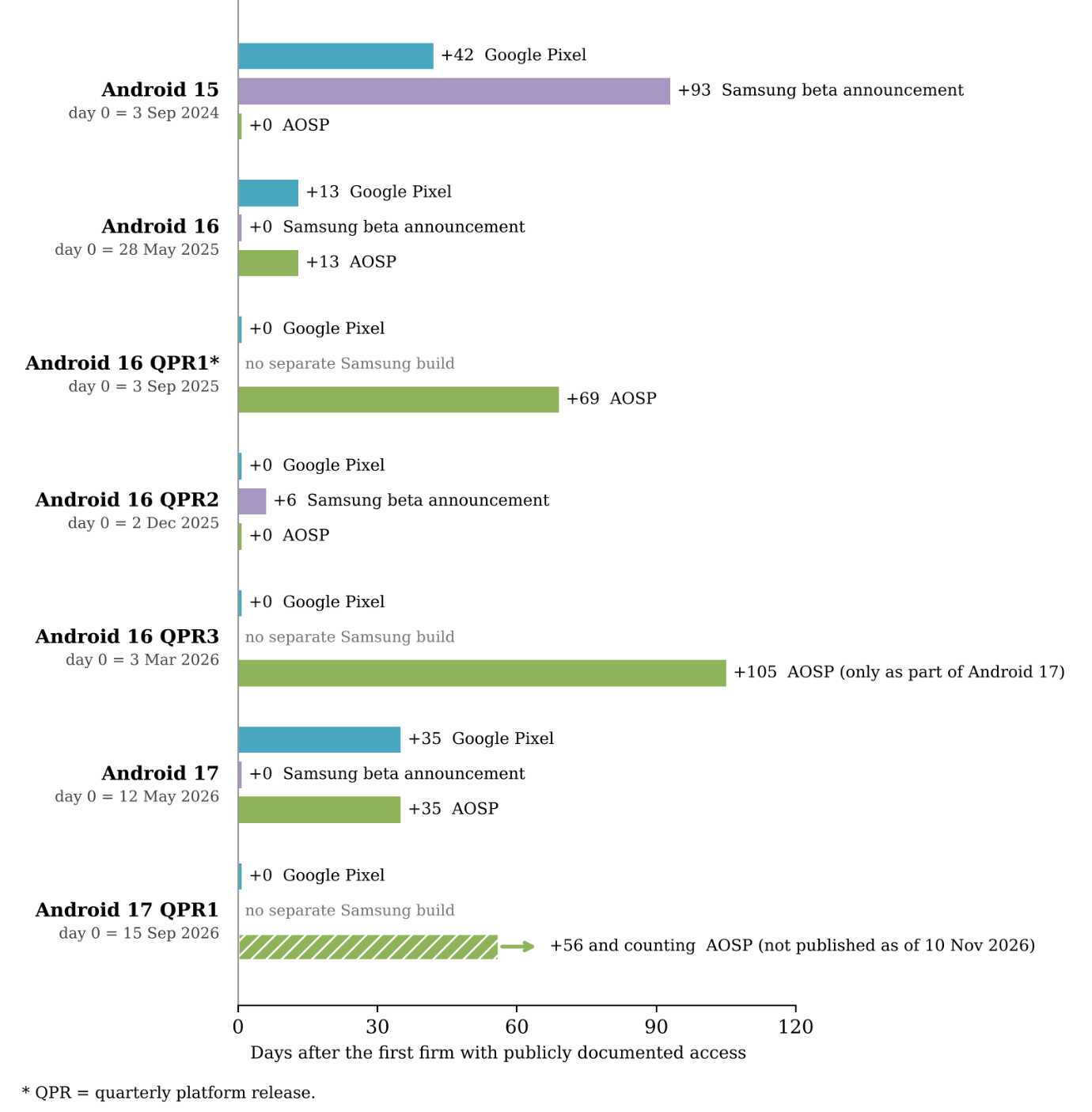
Measured against Google’s own devices, the comparator for self-preferencing, rivals now keep pace with the yearly releases but fall months behind on three of the four quarterly releases. Measured against Samsung, the comparator for discrimination, rivals fall behind even on the yearly releases, because the favoured partner had each of them before Google’s own devices did. For Android 15, the last version developed in the open, rivals received the code first. From Android 16 onwards, the order has reversed. The lag behind Samsung could be longer, because Samsung’s figures are lower bounds. A manufacturer that announces a beta has received the code before then, and only Google and Samsung know when.
4.2 From Lag to Effects
The lag is evidence for the assessment of effects, not a measure of them. The DMA conducts no such assessment. Article 102 requires an authority to show that conduct can produce exclusionary effects. A lag rarely excludes a rival outright, so the usual evidence of foreclosure may not capture it.
The relevant harm is what rivals lose while they wait. Through the mechanism set out in Section 2, a lag can cost a rival its time to market and the users it would have reached while network effects were forming. It can also lead the rival to shift its innovation away from products where it would compete with the owner, towards areas the owner is less likely to enter. Implementation time and any lead the owner gains from advance knowledge add to this disadvantage, but they are effects to be assessed, not part of the lag itself.46 Apple – Features for Connected Physical Devices, supra note 19, ¶ 74(b). The Commission’s guidelines direct attention to this kind of harm in digital ecosystems, asking whether conduct prevents rivals from gaining network and learning effects that would let them compete more strongly later.47 Latham & Tzanetaki, supra note 7, at 330; Wen & Zhu, supra note 4, at 1337–38; Exclusionary Abuse Guidelines, supra note 25, ¶ 94. Other factors, such as product quality and the rival’s own capabilities, also bear on the counterfactual comparison. It is not established that a long lag harms competition, nor that a short one does not.
The rivals whose losses count need not be as efficient as the platform owner, because a lag acts on them before their efficiency can be shown. A rival kept waiting enters later, with fewer users and less experience, so comparing its efficiency with the owner’s would partly measure the effect of the lag itself. The Court of Justice has accepted that the as-efficient competitor test makes no sense where an ecosystem with significant barriers and network effects makes such a competitor practically impossible, and the Commission’s guidelines take the same position for non-pricing conduct.48 Google Android (CJEU), supra note 38, ¶¶ 272–73; see also Case C-680/20, Unilever Italia Mkt. Operations Srl v. Autorità Garante della Concorrenza e del Mercato, ECLI:EU:C:2023:33, ¶ 57 (Jan. 19, 2023); Exclusionary Abuse Guidelines, supra note 25, ¶¶ 92–95. The authority must still show that the conduct is capable of producing exclusionary effects; the point is only that the efficiency test is the wrong way to show it.
4.3 What Measuring the Innovation Access Lag Would Change
Some lag has legitimate reasons. A platform owner may have commercial reasons to delay launching or to ensure confidentiality until the moment of launch. It may also do additional work to secure the platform, or to test a new feature against its own products, which it knows, before opening it to products it does not. A platform owner can also run unstable pre-release versions internally that it would not give third parties.
Both competition law and the DMA allow a platform owner to justify conduct that delays access.49 Android Auto, supra note 24, ¶¶ 74–75; Digital Markets Act, supra note 18, art. 6(7) (second subparagraph); Zach Meyers, Balancing Security and Contestability in the DMA: The Case of App Stores, 20 Eur. Competition J. 639, 651, 656 (2024). In Google Android, the Commission rejected the early-release justification because Google could protect pre-release versions by less restrictive means.50 Google Android (Comm’n Decision), supra note 2, ¶¶ 1178–81. Under the DMA, the Commission rejected Apple’s claim that giving third parties automatic Wi-Fi connection would compromise the integrity of iOS, finding the risk unsubstantiated. It held that an integrity measure cannot be strictly necessary and proportionate if it demands more of third parties than Apple requires of its own services.51 Apple – Features for Connected Physical Devices, supra note 19, ¶¶ 111, 427.
Measuring the lag makes objective justification assessable. In the Android example, the build Google published for the first quarterly release of Android 16 was the same build its own devices had run for 69 days.52 See supra note 45. The wait was therefore not spent changing that code so that others could use it. It may have gone on work the public record does not show, such as testing on other manufacturers’ devices. The measure identifies the period the owner has to account for. Evidence of how long rivals wait would then help an authority decide whether a particular lag goes beyond what legitimate reasons require.
Measuring the lag would also let authorities design remedies around how far rivals stand behind, not only around deadlines, and check whether a remedy has shortened that wait. A remedy could, for example, require that rivals receive access no later than the owner’s favoured partners, which parity under the DMA does not require. A measure also matters where a platform lengthens the wait after rivals have invested in it. Bostoen and Petit propose that such “treacherous turns” be remedied by freezing the previous terms in place. For access timing, that remedy requires knowing what the previous wait was.53 Bostoen & Petit, supra note 12, at 629.
5. Conclusion
Measuring the innovation access lag rests on three principles. The legal question decides whom rivals are compared with. It also fixes the moment the lag starts. In self-preferencing cases, the timing of a rival’s access should be compared with that of the owner’s own services. In discrimination cases, it should be compared with the moment a favoured partner received access. A rival can keep pace with the owner and still fall behind its partners. The lag ends when rivals receive access they can build on. An announcement does not end it, and neither does access that rivals cannot yet use to develop their own products. The innovation access lag measure records the whole wait. Justification is assessed separately. The facts of each case show whether any part of it has a legitimate reason. The approach lets an authority see the full lag before deciding how much of it is harmful and how much of it the owner can account for.