This article is part of the special issue New Measures of Competition in the Digital Economy, prepared in collaboration with the International Center for Law & Economics (ICLE).
Abstract
Antitrust law struggles to measure market power in digital markets. Approaches based on price-cost margins, while technically more correct, are difficult to apply because marginal costs are low or even zero, and there is no workable way to include fixed development costs for an ongoing product. Some promising attempts have been made to use quality reductions as a substitute for price increases. “Indirect” market share measures that rely on market share are less reliable because supply and demand elasticities are higher in digital markets than in more traditional markets. Zero-pricing, low switching costs, and multi-homing all permit market shares to shift abruptly. The record of entry and growth of firms such as TikTok in social media and Grok or DeepSeek in AI demonstrates how vulnerable dominant positions can be.
Because digital sectors are highly dynamic and innovation-driven, antitrust enforcement must exercise caution to avoid misdiagnosing healthy competition as monopoly power. The best approach in such cases is to (1) require higher share numbers to establish a given amount of power; (2) insist that the shares in question be durable; and (3) seek out other types of evidence that links high shares to market power.
Measuring market power for purely digital products is hard, and we still do not have a consensus about how to go about it. First, digital networks are subject to network effects1 that give advantages to larger networks over small ones.2 The effects can even create monopoly in undifferentiated markets. Product differentiation counters the tendency toward monopoly, or winner-take-all, because differentiated firms appeal to different consumer tastes. In a differentiated market strong network effects and competition among multiple firms with sustainable output often occur.3 Many markets for digital products, including social networks, magazines, newspapers, and dating sites, have room for multiple competitors.
What further complicates the market power issue is that most online firms, including those whose output is digital, are highly dynamic.4 According to Department of Commerce data, growth rates are much higher5 in online markets than traditional offline markets, although the difference has recently been narrowing.6 Digital producers in particular change product configurations more frequently than offline firms. As a result, it is very difficult to reason from observations about a firm’s present position to a reliable prediction of what it will look like a year from now. As noted below, in a relatively short period of time Facebook repositioned itself from a “friends and family” focus to one that was used mainly to display short-form videos.7
Metrics that depend on margins between prices and costs are much more difficult to apply to purely digital output. For digital goods an additional unit can be created at a marginal cost equal to zero plus a small amount for distribution costs. This makes any methodology for assessing market power that looks at markups, or margins between price and cost, very hard to apply. Short-run price-cost margins seriously exaggerate the power of digital products. For example, the streamed HD version of Walt Disney’s 2013 movie The Lone Ranger (with Johnny Depp) sells for $19.99, an enormous markup over a marginal cost of close to zero. However, The Lone Ranger ranks as one of the movie industry’s biggest money losers of all time. Long-run measures, which would include development and other fixed costs, would be more accurate, but in order to amortize fixed costs accurately we need to know the full output to which those costs apply. That does not happen until the product has come to the end of its commercial life.
What about indirect measures, using market share instead of markups to estimate power? The dominant way antitrust cases measure market power is “indirectly,” which involves the definition of a relevant market, and then computation of a market share.8 A relevant market is a grouping of products that are very close substitutes to one another, but not substitutes for things that are outside of the market. For example, if we conclude that “electric automobiles” is a relevant market it would follow that a Tesla and a Hyundai EV are close substitutes for one another, but that a Tesla and a traditional gasoline-burning Ford are not.
Measuring market share requires a unit of output, which can be easy in the case of unit products such as nails or pounds of coffee. For digital output it requires more creativity. Simply counting users does not tell us much, because many people sign up for multiple sites but rarely use some of them. In the Meta case Judge Boasberg relied mainly on measures of monthly or daily average usage, even though he acknowledged that this metric exaggerated the effects of some uses, such as watching videos as opposed to glancing at a photo.9
The government relied on market share measures almost exclusively in its antitrust cases against Google and Meta. Google Search has a market share in a market for digital general search engines of about 91%,10 and the Google (search) decision had no difficulty concluding that this was sufficient for monopoly.11 By contrast, the government’s use of market share numbers in its Sherman Act challenge to Facebook’s acquisition of Instagram and WhatsApp was unsuccessful. That decision is under appeal at this writing.12 The court concluded that its market share, calculated to be no more than 54%, was insufficient to make Facebook a monopolist under Sherman Act standards. The United States courts have generally required market shares upwards of 60% or so for unlawful monopolization. EU law, however, will permit a finding of dominance on shares as low as 50%.13
The rationale for using market share as a metric for market power is that it provides a way of assessing the ability of rivals to increase their output in response to a larger firm’s price increase. If a firm with a 10% market share reduces its output and increases its price, other firms in the same market will want to take that firm’s sales. To do that they do not need to cut their price, but they must have the capacity to sell more. In fact, only a relatively small output increase by firms accounting for the remaining 90% will be required. If they can do that quickly and at costs that are roughly the same as they are incurring on current sales, about the only thing that the 10% firm will experience is loss of sales and lower profits.
For example, if a firm currently producing 100 units in a 1000-unit market should reduce its own output by 20%, or 20 units, the market is unlikely to notice. Prices will not increase because the producers of the remaining 900 units can add 20 units to their own production very easily. That would be an average increase of about 2% for each of them. A firm could often do that in a few hours, or at least in a few days – hardly enough for durable monopoly. For most firms an output variation of 2% is a daily occurrence that it can accomplish without significant change to its operations.
By contrast, if a firm with a 90% market share reduces its output by 20%, the firms producing the remaining 10% must nearly triple their own output in order to offset the difference. That makes it much more likely that prices will rise. Most firms producing physical products would need some time to triple their output. If tripling required enlarging or building an additional plant, it could take much longer. Of course, these are fact questions, and the answers vary with the circumstances. For example, a firm with a great deal of unused capacity could expand its output much more quickly than one that is already operating at its maximum.
This is where the fact of digital output becomes relevant. Both supply and demand on digital markets are more elastic than in most offline markets. Consider a periodical such as the digital New York Times. The fixed costs of assembling the digital edition are about the same as for the print edition. Among these fixed costs, news must be gathered and columnists paid, advertising sold, etc. For publications that have both a print edition and an online edition the two versions typically begin with a single text and image file, although the final digital version will require some formatting and design changes.14
Once a particular issue is reduced to a digital file, however, output can be increased almost instantly and very cheaply. The only thing that limits the ability of the digital New York Times to sell an additional “copy” of the July 4 issue is the cost of processing the transaction, which is extremely low. Further, there is virtually no limit on how many copies the NYT can sell. If a product is both digital and does not require a subscription, such as a search engine, these costs of increasing output come close to zero. That is also largely true of digital products that require a login, such as a social network site.15
To be sure, there may be some offsetting congestion issues, such as limits on bandwidth or server space, or perhaps management costs or even competition for user attention.16 However, traditional products face these costs as well. In general, Facebook’s or Google search’s output is much more elastic than General Motors’ output. That makes durable market power less likely. While information is costly to develop and produce, it is cheap to copy.17 While existing servers and communications technology do place limits on the ability of a digital provider to expand, these are not nearly as strong as for traditional production.18
Consider two periodicals that are offered in digital form and regarded as close competitors in a large but product differentiated market. For example, suppose Bon Appétit and Food & Wine are regarded as very close competitors in a market niche for food and cooking magazines. Suppose Bon Appétit decided to increase its digital per copy price and reduce sales by, say, 300,000 copies of each issue. That would be a reduction of about 25% from current output. Food & Wine could increase its own output of digital copies by that amount very quickly. To be sure, these two magazines are not perfect competitors; however, they might be close enough. The questions are two: first, assuming that the content of each magazine remains the same, how many customers would defect from one to the other in the event of a price increase that is not justified by costs? Second, how quickly could one magazine “reposition” by copying attractive content from the other one in response to the second firm’s price increase? Capacity constraints are unlikely and there are no other obvious limitations on consumer ability to switch.
In the extreme case of perfect competition between the two magazines, Bon Appétit’s price increase attempt would fail because Food & Wine would offset the output reduction almost immediately. At the opposite extreme, if readers did not regard the two periodicals as competitors at all, then Bon Appetit could have a great deal of market power, assuming that there were not other close competitors.
Another factor that limits the power of digital output is the fact that product configurations are typically more malleable than for physical products. For example, if one factor that limits competition between Tesla and other EVs is Tesla’s superior self-driving technology, rivals could become closer substitutes by duplicating it. That might require both innovation and engineering, or perhaps negotiation of a license from a willing licensor. On the other hand, if what limits Bon Appétit’s competition with Food & Wine is Bon Appétit’s broader coverage of home cooking, Food & Wine is likely in a position to move into Bon Appétit’s territory quite quickly. Of course these are all questions of fact, and the answers may vary from one situation to another.
Two other things that affect the relationship between usage shares and market power in digital markets are zero pricing and multi-homing. Suppose that the dominant firm is a social network site which is free to users and offers a smartphone app. Several other social networks do the same thing. By one estimate the typical social media user visits, on average, 6.75 different social networks each month.19 One result is that the act of consumer substitution is a different thing for multi-homed digital products than for tactile products. Most people don’t own six different models of cars, bicycles, or even toothpaste. The act of switching generally involves abandoning one product and purchasing another. By contrast, if a smartphone user has Facebook, X, LinkedIn, BlueSky, TikTok, and Instagram installed on her phone, she can move around almost instantly and at no cost. So if for any reason Facebook becomes less attractive to her, she can immediately spend less time there and more on at least one of the others. The court made this observation in the Facebook case. TikTok’s entry into the American market with a product dominated by short user-posted videos was a game changer, going from zero in 2018 to a major player today in a market dominated by giants.20
The Google (Search) court observed the same thing about Grok, an AI chatbot launched by Elon Musk. It grew from nothing to one of the top AI engines in a short amount of time. As the court quoted one expert, “You see entrants like Grok or DeepSeek, that may not have existed six months ago, are now able to reach the level of performance to wind up in the top ten of these models.”21
The aftermath of the Microsoft decree noted a similar change in the market share history of Internet Explorer, Microsoft’s web browser at the time. The case arose at a time when Microsoft was elevating the market share of Internet Explorer through practices targeting its principal rival Netscape. The D.C. Circuit declined to order a breakup. Instead, it removed provisions in Microsoft’s licensing agreements with implementers that required them either to favor Internet Explorer or use it exclusively. With the market opened up, Internet Explorer’s market share began to fall:22
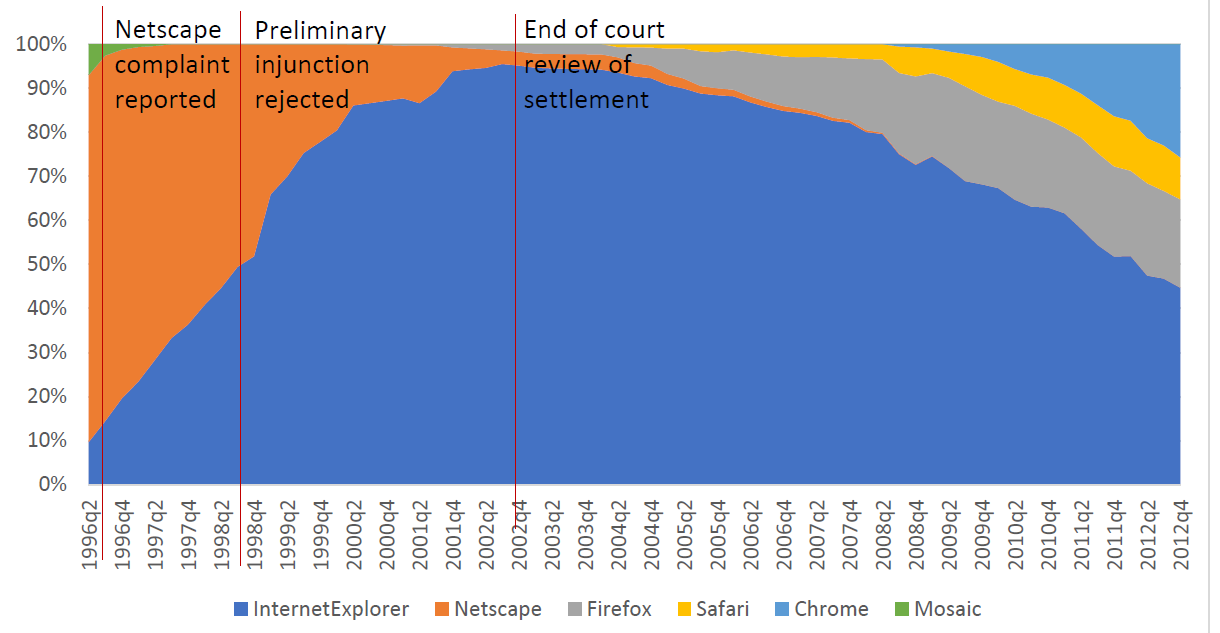
Internet Explorer (blue) experienced rapid growth in market share from 1996 until 2002–2003, the period during which its exclusivity provisions were in place. When the remedy took effect,23 the exclusivity provisions were removed and IE’s market share went into decline. Its fall accelerated sharply after 2008, when Google entered the market with its Chrome browser. Today, worldwide browser usage shares run about 70% for Chrome (Google), 16% for Safari, mainly on Apple devices, and 5% for Edge, which is Microsoft’s successor to Internet Explorer.24
Conclusion
While market share numbers remain useful for assessing digital market power, the link between share and power is much weaker in digital markets than it is in traditional, more tactile markets. The best approach in cases involving digital products is to
-
require higher share numbers to establish a given amount of power;
-
insist that the shares in question be durable, without significant successful new entry; and
-
seek out other types of evidence that links high shares to market power.
The importance of the second point, durability and lack of entry, is that it enables a court to assess substantiality in a market where output is subject to rapid change. Instances of recent successful entry should count strongly against a finding of monopoly power. One word of caution here is that when a single firm owns a dominant market share, new entry may be consistent with dominance because the dominant firm already has significant margins. By contrast, if multiple firms have established profitable positions and are competing with each other, then evidence of successful new entry should defeat any finding of significant market power. Here, the importance of product differentiation emerges. Google Search’s historical dominance is largely a function of the fact that product differentiation has never been a very big element in search. AI may change that. By contrast, differentiation for social networks is extensive and that makes dominant positions more difficult to hold.
On the third point, sometimes other structural advantages enable a particular digital product to retain superiority. For example, Google Search is a digital product that is both free and subject to multihoming. However, the key to its superiority is a search index database that is far larger than that of any rival, including Microsoft’s Bing. While the precise size of the database is a guarded secret, testimony in the Google search trial suggested that it contains about 400 billion documents.25 That gives Google Search advantages, particularly in unusual or idiosyncratic searches where the advantages of the larger database show up.26 That database, which is costly to assemble and maintain, operates as the functional equivalent of a large plant that a rival would have to duplicate. The issues are more akin to new entry rather than simple incremental output from an established asset. Under the district court’s remedies decree, Google will be required to give a non-exclusive license to a single-time snapshot of elements of the database, limited to web page identifiers and basic information. That appears to be less than the equivalent of ordering a firm in the old economy to construct a plant identical to its own and give it to a rival.27 In any event, the licensee of this snapshot will have to make immediate, ongoing efforts to maintain a search engine equivalent in quality to Google’s. As the court also noted, the increasing use of AI in search promises a greater amount of product differentiation, making a dominant position more vulnerable.