
Abstract: This paper proposes a simple yet useful framework for evaluating vertical mergers in digital markets by distinguishing between product-specific and ecosystem-specific network effects. Vis-à-vis no network effects, product-specific network effects amplify foreclosure and steering incentives, as a rival’s growth directly undermines the platform’s product value. Conversely, ecosystem-specific effects dampen foreclosure incentives, because rivals contribute to the overall value of the platform ecosystem. We develop a formal model illustrating how this distinction shapes platform behavior and competitive outcomes. We apply this distinction to real-world examples to illustrate its potential usefulness. Our distinction implies that regulators may want to adopt a stricter standard with no presumption of efficiencies where product-specific effects dominate. In contrast, when ecosystem-specific effects prevail, merger evaluation should mirror traditional vertical merger analysis, thus offering a more nuanced approach to merger evaluation by presenting a practical screening tool to identify problematic vertical mergers in markets featuring network effects.
***
The present paper offers a condensed version of the article “Foreclosure Incentives with Network Effects: A Framework for Screening Digital Mergers,” published in the Journal of Competition Law and Economics.
For years, competition authorities on both sides of the Atlantic have approached mergers in digital markets with growing suspicion. The list of closely scrutinised deals keeps expanding, including Microsoft/Activision, Booking/eTraveli, Meta/Within, Google/Fitbit.[1] Behind much of that scrutiny is the focus on a single issue: Network Effects. Due to these network effects, where a product often becomes more valuable as more people use it, digital markets can “tip” toward one dominant firm. The concern is that a platform which buys or builds its way into a downstream market will use its position to shut competitors out (foreclosure in antitrust parlance). Specifically, the presence of network effects may make such foreclosure both easier and more tempting.
That fear has fuelled a concrete proposal: treat vertical mergers in digital markets as strictly as horizontal ones, and in particular stop presuming that they generate efficiencies. Influential studies from the Stigler Center report to the U.S. Federal Trade Commission’s 2021 decision to withdraw the Vertical Merger Guidelines have pushed in this direction.[2]
The instinct is understandable, but it rests on an implicit assumption that network effects always point the same way and increase foreclosure incentives. They do not. “Network effects” is not one phenomenon but a family of them, and this nuance must be kept in mind during merger control proceedings. This is the heart of our argument. Different types of network effects push a platform’s incentive to foreclose in opposite directions. Some make foreclosure more likely than in an ordinary market (without network effects), while others make it less likely. A framework that treats just the presence of network effects as a red flag will get some cases badly wrong.
What we offer is a simple distinction that can serve as a first-pass screen. It requires no modelling and no new data collection at the outset of an investigation. What it requires is a judgement about where the value of an extra user flows.
Two kinds of network effects
The distinction is between what we call product-specific and ecosystem-specific network effects.
A network effect is product-specific when the value created by additional users stays largely within the product that attracted them and benefits other users of the same product. Music streaming is a good example. When more listeners join Spotify, its recommendations improve, and more artists come on board. This makes Spotify more attractive for users. But little of that benefit spills over to the other apps sitting alongside it in Apple’s App Store. The loop is self-reinforcing, but it is closed and stays within the product or service. Gaming platforms behave similarly. A larger community on one service makes that service better, not the encompassing ecosystem.[3]
A network effect is ecosystem-specific when extra users at one product raise the value of the whole ecosystem and thus also the value of the products of rivals. The chip-design company ARM is a useful illustration. ARM licenses its designs to manufacturers such as Qualcomm and Nvidia. Feedback from any one customer helps ARM improve designs that are then available to all of them. A larger base of licensees attracts more development partners and tools that every licensee can employ. Growth anywhere in the network lifts the value of being anywhere in the network. Data-driven platforms can work the same way, when data generated by one participant improves a service that everyone shares.[4]
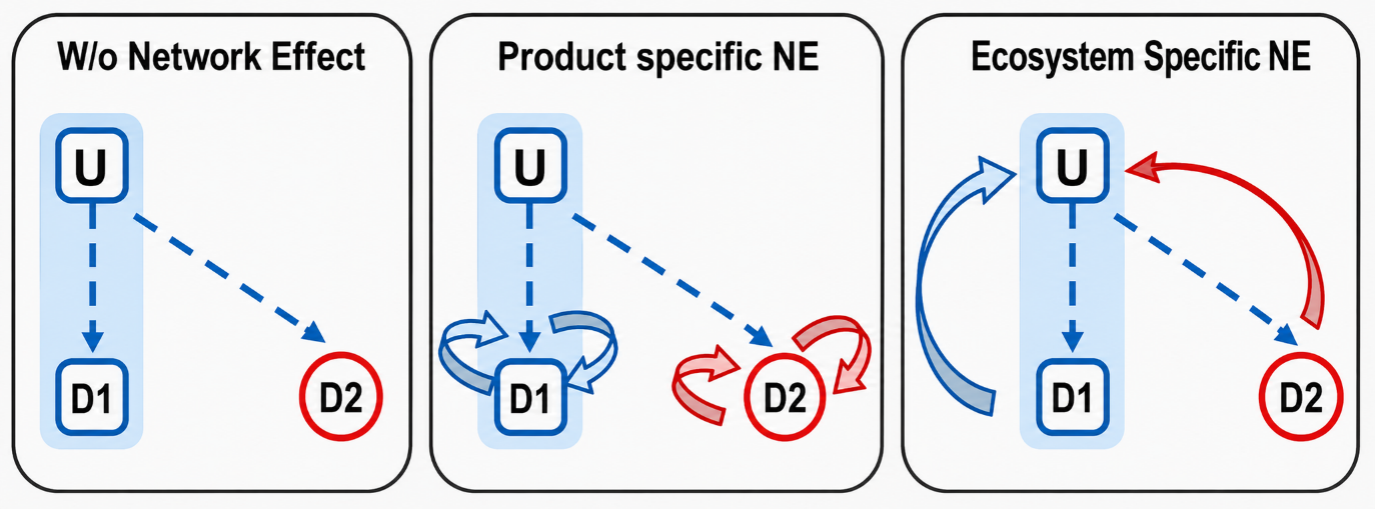
Figure 1. Where the value of an extra user goes. With product-specific effects, it stays within the product; with ecosystem-specific effects, it feeds shared value that lifts every participant, rivals included.
In practice, a platform usually displays both kinds at once. The question a regulator needs to answer is not “which one exists?” but “which one dominates?” from the platform’s point of view.
Why the distinction flips the incentive to foreclose
To see why this matters, picture the setting competition lawyers know well. An upstream platform also sells downstream through its own subsidiary, and it hosts an independent rival that depends on the platform as an essential input. The platform has multiple levers to squeeze that rival in favor of its own product, such as a high access or per-unit fee or burying the rival in search results while steering customers to its own product. The question is whether the platform wants to use those levers to push the rival out.
Start with the benchmark of a market with no network effects at all. In this case, competition economics already has a clear answer from the well-known classic foreclosure analysis of Hart and Tirole (1990). The integrated platform has high incentives to entirely foreclose the rival who sells a close substitute. Full foreclosure is the baseline. Yet if rivals sell imperfect substitutes, foreclosure may be partial.[5]
Now add product-specific network effects to this analysis. When the rival grows, its product becomes more attractive because of its own network, and it pulls demand away from the platform’s product. This increases the network of the platform’s rival, which makes that product/service more attractive, while at the same time making the platform’s own subsidiary relatively worse off. This implies that the demand pull is significantly stronger than it would be in an ordinary market (without network effects). Accommodating the rival on its platform is now more costly than before. The outcome is that the incentive to foreclose is even stronger than in the no-network-effects benchmark. This is also what regulators in the previously mentioned reports were worried about.
Instead, now add ecosystem-specific network effects. In this case, the rival’s growth also enhances the value of the ecosystem, which also flows towards the platform’s own product. As a result, the independent rival of the platform’s own product has partly become a source of value for the platform. Shutting it out would mean throwing away value that props up the platform’s own sales. The platform, therefore, becomes more willing to accommodate the rival than it would be in the case of no network effects. As a result, when the value contributed by the rival’s sales to the ecosystem is large enough, full (and sometimes even partial) foreclosure simply stops being profitable. The following figure describes how different types of network effects affect the incentive to foreclose a rival vis-à-vis the benchmark of no network effects.
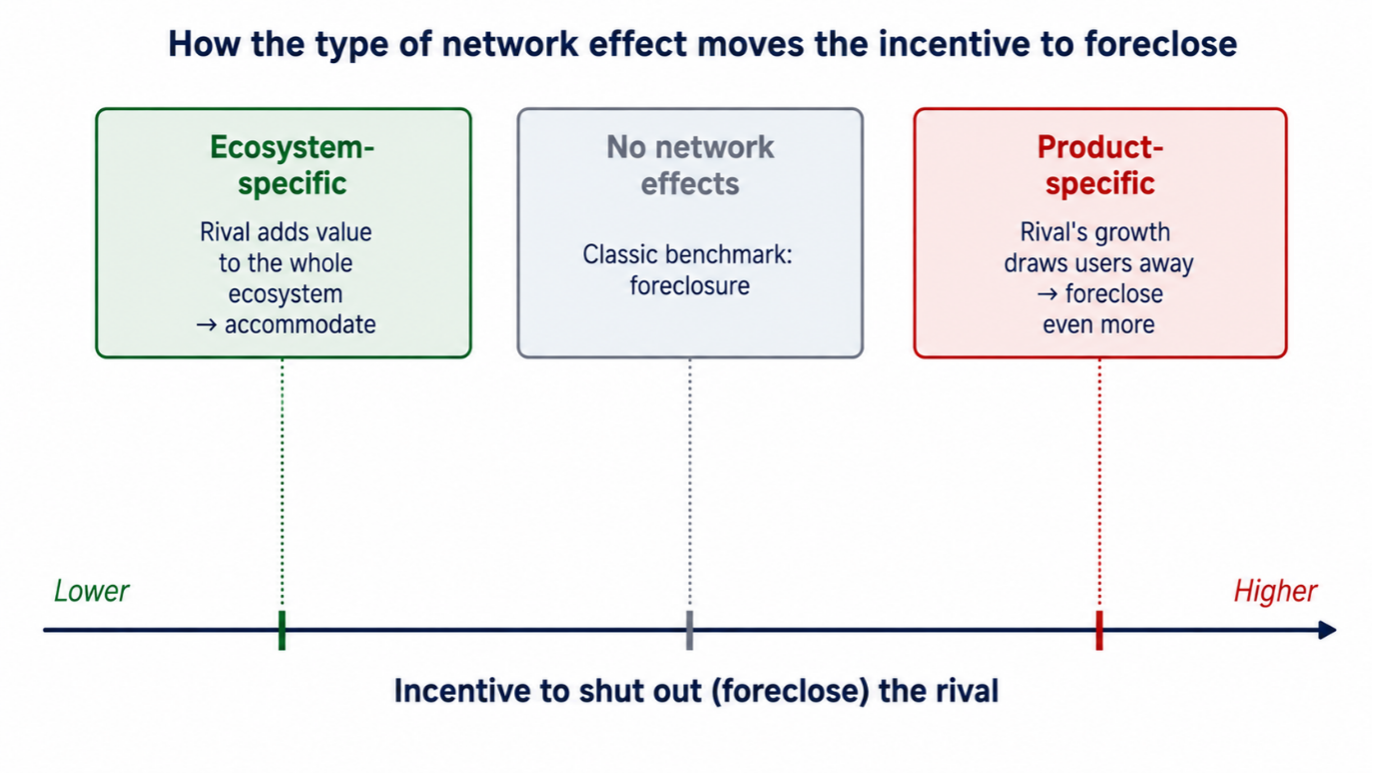
Figure 2. The same self-reinforcing dynamic pushes toward more foreclosure when effects are product-specific and toward accommodation when they are ecosystem-specific.
Platform ecosystems may feature both types of network effects in different orders of magnitude. Thus, it is worth dedicating more time to understanding how this network arithmetic works. On the one hand sits the gain from diverting the rival’s customers to the platform’s own product, which is the argument for the classical foreclosure motive. This motive is magnified by product-specific effects because each diverted customer enlarges the platform’s own network. On the other side sits the value the rival’s sales add to the shared ecosystem, which the platform captures through its own product and destroys by shutting the rival out. Foreclosure stops paying at the point where the second outweighs the first.
How large does the rival’s contribution have to be? In our article, the comparison has two features that provide further insights. First, the (minimum) level of value the rival generates for the ecosystem (denoted as α in our model) should be large. Specifically, for accommodation to beat exclusion, the value generated through the rival’s sales (or success) for the shared ecosystem has to be large relative to the value that stays inside the rival’s product. Second, this minimum level of value generation (the aforementioned α in the paper) falls as the value of network effects grows stronger. A direct implication of this result is that foreclosure of a rival is less likely when the value associated with the network increases. This is because the platform’s gains from foreclosing its rival (resulting in a smaller network) shrink as the value of network effects increases. Thus, by foreclosing its rival, the platform also shrinks the network of its own ecosystem and, as a result, lowers the value of its own product.
A rule of thumb for identifying the dominant type of network effect. While studying which type of network effect dominates is a purely empirical exercise, we offer some pointers. A simple way to identify what type of network effect is dominant is by collecting evidence on what happens to the platform’s ecosystem when the rival gains an additional user. If the answer is “no effect except increased commissions”, the network effects are product-specific, as they do not directly impact the platform’s ecosystem. Instead, if the answer is that the platform’s ecosystem benefits from increased demand at the rival, the network effects are ecosystem-specific. For instance, data from the rival feeding a common model, a design or standard that improves with increased (feedback or) use at the rival, a captured demand base whose demand also spills over to several products/services on the ecosystem and further increases transactions.
Three caveats are in order. Where the rival is itself a platform with its own two sides — artists and listeners, developers and gamers, buyers and sellers — the loop closes inside the rival. In this case, the dominating type of network effects will usually be product-specific — i.e., for instance, music streaming platforms hosted on Apple’s App Store. The classification is also segment (market)-specific rather than firm-specific. The same company can sit on either side of the line (as shown in Fig. 2) in different parts of a single transaction, as Microsoft/Activision below illustrates. As the threshold needed to deter a platform’s foreclosure incentive can be substantial, mixed evidence from preliminary analysis should be read as product-specific. In conclusion, the ecosystem-specific effects, we theorize, needs affirmative support rather than plausibility.
The same story for self-preferencing
Fees are not the only lever. Increasingly, the concern in digital markets and a centrepiece of the EU’s Digital Markets Act is self-preferencing. Specifically, a platform steering users toward its own product through rankings, defaults, and other design elements. The same logic carries over. Steering shifts attention from the rival to the platform’s own product. The rival’s sales fall and the platform’s rise, though total output shrinks as consumers may view products that are not a good fit.
As before, when network effects are product-specific, the platform wants to steer more, for the same reason it wants to foreclose more. Capturing the rival’s users directly strengthens its own product’s value offering and thus attracts more users. When network effects are ecosystem-specific, the platform wants to steer less. This is because aggressive steering shrinks total activity and starves the shared value the platform itself depends on. In that sense, self-preferencing is analytically close to foreclosure, and the product-versus-ecosystem distinction can be easily applied here.
Applying the lens to real cases
The framework we propose is a simple yet informative way of initially screening cases that may be potentially problematic, not a verdict machine. A few illustrations show how it works.
Microsoft/Activision. The obvious concern was that, in the market for gaming consoles, Microsoft would withhold Call of Duty from its rival PlayStation. It did the opposite: keeping Activision titles on rival platforms and signing a ten-year licensing agreement with Nintendo.[6] The Commission’s reasoning tracks that logic: withholding would sacrifice the revenues and the player base the franchise generates on rival platforms, and those exceed what Microsoft would gain by pushing players towards Xbox. Multiplayer titles are network goods whose value is generated across platforms and player communities rather than inside one console’s silo.[7] The Commission’s remaining concern, and the commitments it accepted, sat in cloud game streaming, where withholding would have considerably strengthened Microsoft’s own streaming service and, through it, Windows. One transaction, two answers, because the network effects run differently in the two segments.
Booking/eTraveli. The Commission prohibited Booking’s acquisition of the flight agency eTraveli in explicit ecosystem terms: flights would work as a customer-acquisition channel feeding Booking’s already dominant hotel platform, reinforcing the network effects and entry barriers that protect it.[8] This is the mirror image of our point and worth being precise about, because our framework does not say that ecosystem effects are always benign. Ecosystem-specific effects are useful in the context of a vertical merger and make a platform less likely to exclude a rival complementor, because that complementor’s presence generates value. That is a reason to reconsider the foreclosure theory in that context. Nevertheless, as the Booking.com case shows, enhanced ecosystem effects bring focus on entrenchment theories, since the same spillovers make the ecosystem harder to compete with.
Nvidia/ARM. ARM’s network effects look strongly ecosystem-specific: its value grows as its whole licensee and developer community grows. A vertical combination here carries a lower foreclosure risk, so ordinary vertical merger review is adequate — broadly how the deal was in fact handled.[9]
Google/Fitbit. This one is genuinely mixed. Google, by acquiring Fitbit, entered the smartwatch market in competition with other smartwatches on its Android ecosystem. Aside from adding Fitbit into its hardware portfolio, Google also gained another source of data, which could have improved its ad targeting. Rivals of Fitbit connected to the Android ecosystem and the (many) users of rival wearables also share data with Google through the Google Fit app. In that sense, when viewed from the perspective of data used by Google in its ad ecosystem, the network effects become ecosystem-specific. Specifically, rivals’ growth then creates value for the Google search ecosystem too. The practical tell for a regulator is the value and volume of data the customers of Fitbit’s rivals share with Google. The more they share, the more ecosystem-wide the effect, and the weaker the foreclosure concern.[10]
Apple, and the conduct side. Our clearest examples of product-specific effects — Spotify and Epic on Apple’s App Store — are conduct cases rather than mergers, but the logic we present carries over quite well. What the framework identifies is an incentive to raise a rival’s costs or to steer users away from it. Whether a platform acquires that incentive through a merger or by entering into direct competition with the applications it hosts, the trade-off is the same one.[11] Nevertheless, any such conduct engages Article 102 TFEU, or is pre-empted by the DMA.[12]
None of these is a final answer. They show that the distinction is compatible with the kind of qualitative evidence authorities already gather.
An objection: isn’t this a design choice?
One objection deserves further deliberation. The type of network effect is not purely a fact about a market; instead, it is partly something a platform chooses. Whether data collected by one application improves only that application, or feeds a model shared across the ecosystem, or whether interfaces let complements build on one another are design choices. Therefore, a platform under review has an obvious interest in claiming that the dominant network effects are ecosystem-specific to benefit from our proposal of a relatively lower regulatory burden.
Three rebuttals blunt this objection. First, lasting successful networks in platform markets are quite difficult to achieve, and the stability of these networks is quite sensitive to design changes.[13] Second, this claim is testable using evidence authorities already gather, such as market shares; demand interdependencies, such as demand flows or data flowing from the complement into shared services; and improvements internally attributed to third-party activity. The burden of producing this evidence sits with the party asserting the efficiency. Third, and most useful in practice, a platform claiming ecosystem-specific effects is claiming that its rivals’ growth is valuable to it. Such claims require evidence that the platform must furnish or draw from its observed conduct in the market. For instance, does the platform invest in enhanced interoperability, data access, and non-discrimination commitments? Such investments could be viewed as inconsistent with conduct that cut complementors off from the shared layer. In conclusion, a platform arguing its ecosystem thrives on complementors’ success, while its market conduct offers strong evidence to the contrary, has lost the credibility of its argument.
What it means for merger review
The distinction translates into a simple, front-end screening process, not replacing the full analysis that follows.
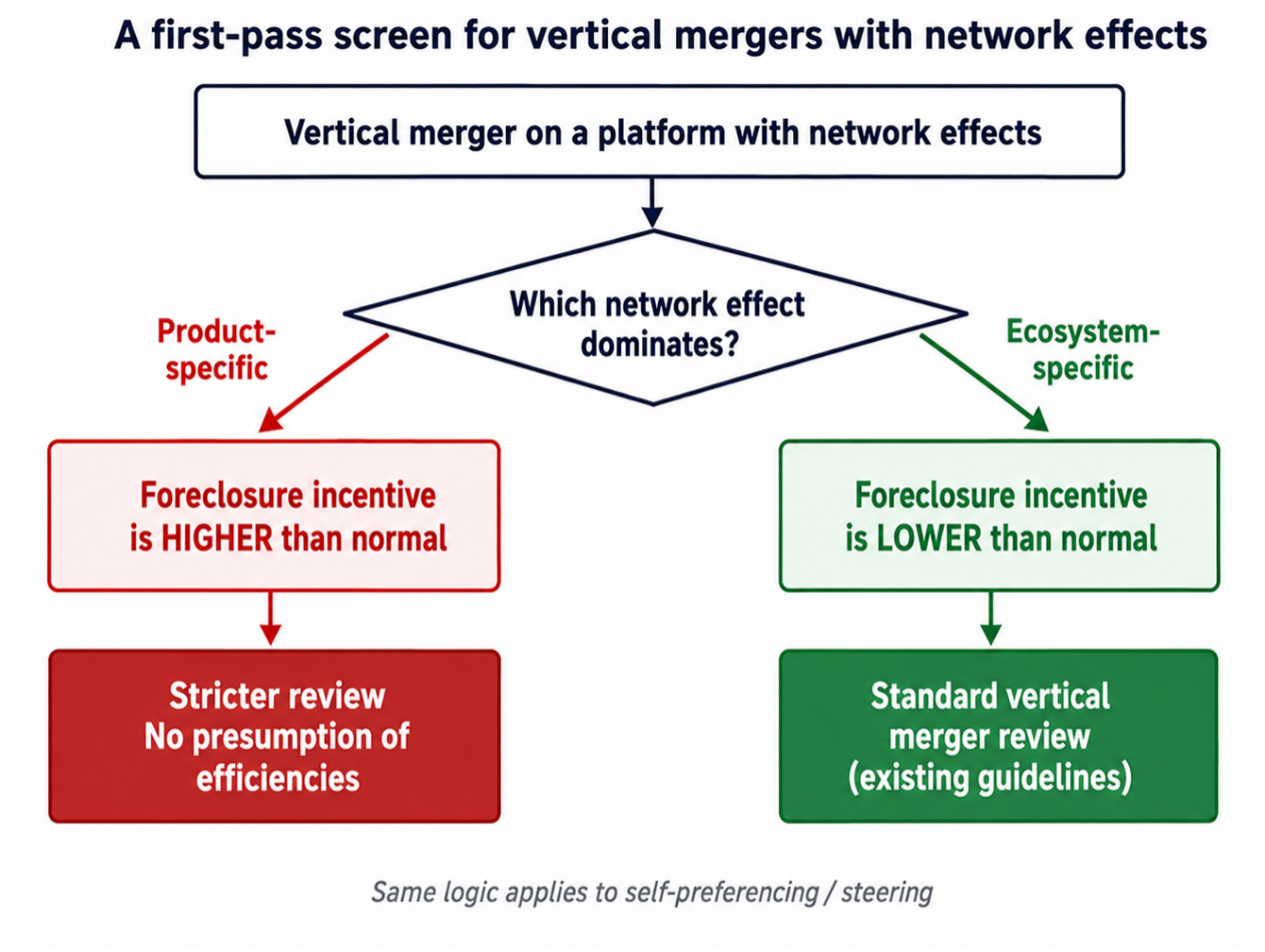
Figure 3. A first-pass screen. Identify the dominant network-effect type, then route the merger to the appropriate standard of review.
First, identify which type of network effect dominates on the platform. Second, where product-specific network effects dominate, adopt the stricter posture that recent policy has urged. Specifically, scrutinise the deal closely and do not presume efficiencies. This is because foreclosure incentives are heightened relative to the case without network effects. Third, in cases where ecosystem-specific network effects dominate, the foreclosure incentive is actually lower than the well-studied case without network effects. In this case, the established non-horizontal merger guidelines are enough, and there is no need for extraordinary treatment. This is the part the current debate tends to miss.
The value of this screen is that it distinguishes mergers that entrench dominance from those that build broader ecosystem value. A blanket presumption against digital vertical mergers cannot make that distinction and imposes unnecessary regulatory burden on benign deals.
Conclusion
Network effects are not automatically anticompetitive, and they are not automatically benign. The useful question for a competition lawyer facing a digital merger is not whether network effects are present, as they almost always are, but what kind they are. Asking that question early, and answering it with evidence already within reach, can direct scrutiny towards the deals that deserve it and spare the ones that do not.
Johannes Johnen* and Shiva Shekhar**
*Université catholique de Louvain
** Tilburg University
***
References
Caillaud, Bernard, and Bruno Jullien. “Chicken & egg: Competition among intermediation service providers.” RAND journal of Economics (2003): 309-328.
Carroni, Elias, Leonardo Madio, and Shiva Shekhar. “Superstar exclusivity in two-sided markets.” Management Science 70.2 (2024): 991-1011.
Hart, Oliver, et al. “Vertical Integration and Market Foreclosure.” Brookings Papers on Economic Activity. Microeconomics, vol. 1990, 1990, pp. 205–86. JSTOR, https://doi.org/10.2307/2534783. Accessed 25 Aug. 2026.
Jullien, Bruno, and Alessandro Pavan. “Information management and pricing in platform markets.” The Review of Economic Studies 86.4 (2019): 1666-1703.
Padilla, Jorge, Salvatore Piccolo, and Shiva Shekhar. “Vertical control change and platform organization under network externalities.” (2022).Rey, Patrick, and Jean Tirole. “A primer on foreclosure.” Handbook of industrial organization 3 (2007): 2145-2220.
[1] Microsoft/Activision Blizzard (Case M.10646), cleared with commitments on 15 May 2023; Booking Holdings/eTraveli Group (Case M.10615), prohibited on 25 September 2023, under appeal (Case T-1139/23); FTC v Meta Platforms (N.D. Cal. 2023); Google/Fitbit (Case M.9660), cleared with commitments on 17 December 2020.
[2] Stigler Committee on Digital Platforms, Final Report (2019), 78: “Courts should not presume efficiencies from vertical transactions.” FTC, Statement on the Withdrawal of the Vertical Merger Guidelines, 15 September 2021.
[3] The within-product externality of the canonical model: M.L. Katz and C. Shapiro, “Network Externalities, Competition, and Compatibility” (1985) 75 American Economic Review 424.
[4] ARM runs public design-review and errata processes and hosts a partner ecosystem whose tools are available to all licensees, so improvements prompted by one customer reach the rest.
[5] O. Hart and J. Tirole, “Vertical Integration and Market Foreclosure” (1990) Brookings Papers on Economic Activity: Microeconomics 205; for a survey, P. Rey and J. Tirole, “A Primer on Foreclosure”, in Handbook of Industrial Organization, vol. 3 (2007).
[6] Case M.10646 – Microsoft/Activision Blizzard, decision of 15 May 2023, cleared subject to ten-year commitments on cloud game streaming. Separately, Microsoft concluded what its President described as “a binding, 10-year, definitive legal agreement with Nintendo”, obligating it “to make Call of Duty available for Nintendo and its Switch devices”: Brad Smith, press conference, Brussels, 21 February 2023, transcript available at news.microsoft.com. The agreement was signed during the review and was conditional on the acquisition closing; no Call of Duty title had appeared on a Nintendo platform as of August 2026. See Press Release.
[7] Carroni et al. (2024) show that higher Superstar ancillary revenues discourage post-merger foreclosure by making rival platforms more valuable revenue sources. These revenues, thus, resemble ecosystem-specific benefits.
[8] Case M.10615, decision of 25 September 2023 — the first prohibition resting on an ecosystem theory of harm. The decision is under appeal and the General Court is due to rule on 9 September 2026, Case T-1139/23.
[9] Anticipated acquisition by NVIDIA Corporation of Arm Limited, CMA report to the Secretary of State for DCMS, 20 July 2021 (executive summary published 20 August 2021); the transaction was abandoned in February 2022.
[10] Case M.9660, decision of 17 December 2020, cleared subject to ten-year commitments on advertising data, Web API access and Android interoperability.
[11] Case AT.40437, Apple – App Store Practices (music streaming), decision of 4 March 2024; Epic Games v Apple (N.D. Cal. 2021), affirmed in relevant part (9th Cir. 2023).
[12] Case AT.40437, Apple – App Store Practices (music streaming), decision of 4 March 2024; Epic Games v Apple (N.D. Cal. 2021), affirmed in relevant part (9th Cir. 2023).
[13] See Caillaud and Jullien (2003), Jullien and Pavan (2019).