
Abstract: The abuse of economic dependence has attracted renewed attention, largely as a result of the growing policy focus on fairness in digital markets. Rules originally designed to address bargaining-power imbalances in traditional commercial relationships are increasingly being recast as instruments of digital-market enforcement. Their scope and antitrust character, however, remain uncertain. This uncertainty reflects a basic tension. If antitrust law is concerned with protecting competition rather than individual trading partners, it is not immediately clear why abuses of economic dependence should fall within its domain rather than that of contract law. Conversely, if such abuses are capable of affecting market dynamics, the boundary between economic dependence and dominance becomes difficult to maintain. Against this background, the paper draws on transaction cost economics to reassess rules on abuse of economic dependence and to develop a framework for identifying the scope and conditions under which such conduct may be treated as a standalone antitrust offence.
***
Despite differences in scope and institutional design, recent initiatives across several jurisdictions to regulate digital markets are animated by a common concern: the risk of excessive concentration of power in the hands of a few firms and the related policy objective of restoring fairness in the digital economy. In this scenario, the concept of economic dependence—also referred to as superior bargaining power or relative market power—has attracted renewed attention. Its revival forms part of a broader reassessment of the traditional antitrust understanding of market power in light of the rise of large online platforms. In this context, both old and new rules on superior bargaining power seek to address bargaining asymmetries between large online platforms and their business users. These asymmetries are regarded as capable of undermining a fair distribution of value among the various actors contributing to the digital ecosystem.
A notable example is the investigation launched in 2023 by the Italian Competition Authority against Meta for an alleged abuse of economic dependence in the context of negotiations with the Italian collective management organisation SIAE concerning the renewal of an expired licence for the use of music rights on Meta’s social media platforms.[1] According to the Authority, Meta may have unjustifiably interrupted the negotiations by submitting a take-it-or-leave-it offer on allegedly inadequate economic terms and by failing to provide SIAE with the information necessary to assess the fairness of the proposal. The investigation marked the first application of the new national provision introducing a rebuttable presumption of economic dependence where an undertaking relies on intermediation services provided by a digital platform that plays a key role in reaching end users or suppliers, including by virtue of network effects or access to data.
This revival of the abuse of economic dependence prompted me, in a recent paper forthcoming in the Journal of Competition Law and Economics, to examine its precise contours.[2] Indeed, the legal framework remains highly fragmented: some jurisdictions incorporate these rules into competition law, while others locate them in unfair competition legislation, civil codes, or sector-specific regimes.
Provisions on relative market power raise a twofold legal dilemma. On the one hand, in light of the settled principle that antitrust law protects competition rather than individual competitors, it is difficult to draw a clear line between harms that are merely contractual in nature and those that affect the competitive process—the latter alone warranting antitrust intervention. On the other hand, where a significant market effect can be established, it remains unclear why the conduct should not instead be assessed under the existing framework for abuse of dominance.
As a result, for scholars and policymakers, the paradox of abuse of economic dependence raises two fundamental questions. First, if antitrust law is intended to protect competition, whereas rules on economic dependence are primarily designed to protect weaker trading partners, under what circumstances should such rules be enforced within the framework of competition law? Second, if abuses of relative market power are deemed relevant to the competitive process, when should they be treated differently from traditional abuses of absolute market power?
The application of existing and emerging rules on economic dependence to digital ecosystems may further increase uncertainty as to the nature of this alternative concept of market power and the conditions under which it should trigger antitrust intervention.
Indeed, concerns about the substantial bargaining power of large online platforms vis-à-vis their business users have played a central role in the competition policy debate. By calling into question the effectiveness of traditional antitrust enforcement in digital markets, these concerns have also contributed to the emergence of ex ante regulatory instruments. In this respect, a degree of functional proximity can be identified between the European Digital Markets Act (DMA) and the concept of abuse of economic dependence, insofar as both address asymmetries in bargaining power. Under the DMA, the objective of ensuring fairness is directed precisely at imbalances arising from the superior bargaining position of gatekeepers, which may prevent business users from fully appropriating the benefits generated by their own contributions.
Against this background, the Italian Meta/SIAE investigation illustrates the risks associated with an overly expansive definition of economic dependence. Rather than grounding the finding of dependence in Meta’s specific competitive advantages deriving from indirect network effects or access to data, the Italian Competition Authority appeared to infer SIAE’s economic dependence primarily from the fact that Instagram and Facebook are among the most significant social networking platforms worldwide and that Meta enjoys a dominant, or at least leading, position vis-à-vis its competitors. The Authority further stated that the new provision should be interpreted in light of the broader regulatory framework for digital markets, given its shared objective with the DMA of promoting fairness in online markets characterised by platform gatekeepers.
This approach, however, risks diluting the distinctive function of economic dependence by conflating it with both dominance under competition law and gatekeeper status under the DMA. While undertakings dealing with a dominant firm or designated gatekeeper may be more likely to find themselves in a position of economic dependence, that circumstance alone should not be sufficient to establish such dependence. Otherwise, the rationale for a separate prohibition of abuse of economic dependence becomes unclear, particularly where the conduct at issue could already be addressed under traditional antitrust rules or the DMA. The immediate risk is one of enforcement overlap and double jeopardy, namely the possibility of sanctioning the same undertaking twice for substantially the same conduct.
These concerns were echoed by the Italian Supreme Administrative Court, which upheld Meta’s appeal and clarified that the “key role” requirement introduced for intermediaries operating in multi-sided markets cannot be automatically equated with market power.[3] The definition of economic dependence remains unchanged and continues to require proof that the allegedly dependent party lacks reasonably available alternatives. In the case at issue, the fact that Meta may be regarded as dominant under competition law or as a gatekeeper under the DMA did not alter the conclusion that its platforms did not appear to constitute the primary channel through which SIAE could reach consumers of musical works. This conclusion was reinforced by the fact that SIAE is itself the dominant collecting society in the national market and derives only a marginal share of its revenues from Meta’s platforms.
In such a scenario, the paper provides a comparative analysis of national provisions on the abuse of economic dependence, assessing both their consistency with the insights of transaction cost economics and their effectiveness in offering clear criteria to distinguish such practices from conduct already prohibited as abuse of dominance. It then outlines a proposal to ensure that the antitrust application of abuse of economic dependence is aligned with the principles of transaction cost economics.
Conversely, the present investigation does not examine Regulation (EU) 2019/1150 on promoting fairness and transparency for business users of online intermediation services (the P2B Regulation). Indeed, although that legislative initiative was prompted by concerns relating to asymmetries in bargaining power, its provisions essentially impose transparency obligations. Notably, the P2B Regulation recognises that online intermediation services may be crucial to the commercial success of undertakings that rely on them to reach consumers, and that, given the increasing dependence of business users on such services, providers may enjoy superior bargaining power, enabling them to act unilaterally in ways that may be unfair and harmful to the legitimate interests of business users and, indirectly, consumers. Nevertheless, although the Regulation leaves open the possibility of further measures, its operative provisions are primarily designed to enhance transparency rather than to prohibit or prescribe specific forms of conduct.
The comparative overview of national provisions reveals a broadly convergent understanding of economic dependence, which is generally defined by reference to the absence of reasonably equivalent and available alternatives for the weaker party. Austrian law represents the main exception, framing dependence more generally as a situation in which one undertaking depends on the continuation of business relations. French law formally removed the lack-of-alternatives requirement in 2001; however, both Supreme Court case law and the practice of the competition authority continue to treat the absence of effective market alternatives as a necessary condition for establishing economic dependence. Some jurisdictions, notably Belgium, Germany, and Italy, supplement this criterion with an additional focus on bargaining power, defining economic dependence by reference to a significant imbalance between the parties or to the ability of one undertaking to impose rights, obligations, or conditions that would not be accepted under normal market circumstances.
Greater fragmentation emerges with respect to the requirement of competitive harm, namely whether the abuse must affect the market or the structure of competition. This divergence appears partly shaped by the influence of the German and French enforcement models. In particular, the perceived effectiveness of the German approach is often attributed to the absence of an explicit requirement to prove market-wide effects.
As regards the scope of abusive conduct, most jurisdictions provide non-exhaustive lists of prohibited practices. However, there is no clear substantive distinction between the types of conduct covered by the abuse of dominance and those falling within the prohibition of abuse of economic dependence. The latter may encompass both exploitative and exclusionary practices, including refusals to deal, discriminatory or unfair trading conditions, arbitrary termination of business relations, and the imposition of supplementary obligations as a condition for concluding contracts.
Finally, the introduction of platform-specific provisions in some jurisdictions appears to pursue a strategy of differentiated treatment rather than a mere extension of existing economic dependence rules to digital platforms. The reforms adopted in Austria, Germany, and Italy seem to share a common objective: facilitating enforcement in digital markets. In this respect, particularly in Europe, abuse of economic dependence may operate as an enforcement shortcut for national competition authorities, complementing—or potentially competing with—regulatory instruments such as the DMA. Indeed, like the DMA, it does not require proof of dominance or the prior definition of a relevant market. Its main institutional appeal therefore lies in its ability to circumvent some of the evidentiary and analytical burdens associated with traditional antitrust enforcement.
Table 1 summarizes the results of the analysis of national legislation that treats abuse of economic dependence as an antitrust offence.
Table 1. The abuse of economic dependence as an antitrust violation: distinctive features
| Countries/
Features |
Lack of reasonably equivalent alternatives | Imbalance of bargaining power | Effect on the market | Distinctive forms of abuse | Specific reference to digital intermediaries |
| Austria | N | N | N | N | Y |
| Belgium | Y | Y | Y | N | N |
| Cyprus | Y | N | N | N | N |
| France | Y | N | Y | N | N |
| Germany | Y | Y | N | N | Y |
| Italy | Y | Y | Y | N | Y |
| Portugal | Y | N | Y | N | N |
| Switzerland | Y | N | N | N | N |
To address this uncertainty, the paper argues against relying primarily on fairness, whose inherent indeterminacy offers limited guidance in defining the scope of the offence. Instead, it adopts a law-and-economics approach grounded in transaction cost economics. This literature shows how contractual governance is shaped by the specific investments that parties undertake to sustain a trading relationship—commonly described as asset specificity. It has traditionally been used to explain and mitigate opportunism in distribution agreements and relational contracts, namely governance structures that operate as alternatives to the internalisation of transactions through vertical integration.
Transaction cost economics may provide a common analytical foundation for the regulation of economic dependence. Since economic dependence is premised on the absence of reasonably equivalent and available alternatives for the weaker party, the notion of asset specificity offers a particularly useful framework for identifying situations in which an undertaking’s outside options are substantially constrained, thereby exposing it to the risk of hold-up. Where one party makes sunk, relationship-specific investments, its outside options may become constrained, thereby increasing its exposure to opportunistic conduct by its trading partner.
Applied to digital markets, this framework suggests that economic dependence should be assessed by reference to the extent and relevance of such investments within platform ecosystems. Although the degree of asset specificity may vary according to the platform’s business model, ecosystem relationships are often built on tailored forms of integration among participants, designed to create, allocate, and sustain value. Relation-specific investments by complementors are, indeed, an essential feature of ecosystems. Participation in an ecosystem typically requires a degree of customisation, both in the technological configuration needed to provide services through the platform and in compliance with the platform’s governance rules. The greater the degree of customisation, the lower the fungibility of these investments and, consequently, the stronger the complementor’s dependence on the ecosystem.
Transaction cost economics is also crucial to clearly define the conditions and boundaries of application to avoid overlap with the concept of abuse of a dominant position. Notably, consistent with this framework, an abuse of economic dependence under antitrust law should be found only when the stronger undertaking forces or exploits a renegotiation of terms, interrupts or threatens to terminate the business relationship in order to pressure the acceptance of such changes, ultimately leaving the trading partner worse off. Indeed, it is only in these scenarios that holdup will materialize, allowing the party with superior bargaining power to expropriate quasi-rents generated by relation-specific sunk investments.
This approach would also help to identify relation-specific investments correctly. It is important, in particular, to distinguish investments induced by the stronger party’s terms and conditions from those resulting from the weaker party’s voluntary business choices. In the latter case, a firm that has engaged in a self-lock-in strategy should not be regarded as economically dependent, since rules on abuse of economic dependence are not intended to protect undertakings from mistaken risk assessments. Limiting abusive conduct to subsequent changes to the original terms and conditions imposed by the stronger party would help avoid such errors.
For similar reasons, intervention is not warranted where, at the time the claim of economic dependence is raised, the business relationship has generated revenues for the allegedly weaker party exceeding the value of its relation-specific investments. In that situation, protection against economic dependence would effectively amount to granting one party a form of business life insurance at the counterparty’s expense. The relationship between relation-specific investments and revenues should therefore operate as a threshold condition. Accordingly, when a claim of economic dependence is raised, the antitrust authority should verify that the relation-specific investments made by the allegedly dependent party exceed the revenues generated within the business relationship. This assessment is necessary to determine whether the party remains exposed to the risk of hold-up and lacks viable alternatives outside that relationship.
Finally, because the exploitation of relation-specific investments cannot occur before such investments have been made, refusals to deal with new business partners, as well as trading practices imposed at the outset of a business relationship, should not fall within the scope of abuse of economic dependence rules. To the extent that these practices raise competition concerns, they are already addressed by the traditional framework governing abuse of dominance and should therefore be assessed under standard antitrust analysis.
Under this proposal, grounded in transaction cost economics and summarized in Figure 1, the scope of abuse of economic dependence would be more clearly defined, thereby avoiding problematic overlaps with cases involving absolute market power. As a standalone antitrust offence, abuse of economic dependence would capture practices that fall outside the reach of traditional antitrust tools, filling an important enforcement gap across the economy, including in digital markets.
Figure 1. Antitrust abuses: absolute v. relative market power
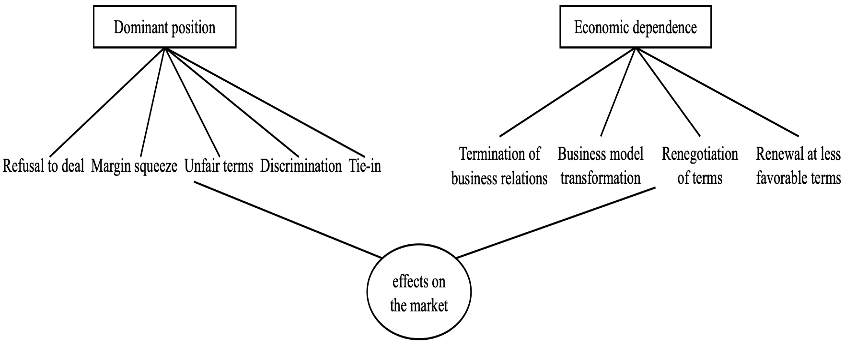
In summary, establishing a condition of economic dependence should require competition authorities to identify the relationship-specific investments undertaken by the allegedly dependent firm. The analysis should then determine whether those investments materially constrain the weaker party’s ability to redirect its activity toward alternative trading partners. Economic dependence would therefore arise where the firm’s sunk, relationship-specific commitments render outside options economically unviable or substantially less attractive. Once such dependence has been demonstrated, enforcement should concentrate on conduct through which the stronger undertaking is able to appropriate the quasi-rents associated with those investments.
On this account, an abuse of economic dependence should be established only where the stronger party uses its superior bargaining position to alter the distribution of surplus after relationship-specific investments have been made. This may occur, for example, where it compels or opportunistically exploits the renegotiation of contractual terms, suspends the commercial relationship, or threatens termination in order to secure acceptance of less advantageous conditions. In such circumstances, the weaker party may be placed in a position in which rejecting the revised terms would entail the loss of sunk investments, thereby enabling the stronger party to capture part of the quasi-rents generated by those investments. This is the paradigmatic hold-up problem. Conduct of this kind may also fall outside the effective reach of conventional abuse-of-dominance rules, particularly where the stronger undertaking does not possess dominance in a properly defined relevant market.
Conversely, refusals to deal with prospective counterparties, as well as contractual terms imposed at the inception of a commercial relationship, should generally lie outside the scope of rules prohibiting abuse of economic dependence. At that stage, no relationship-specific investment has yet been sunk and, accordingly, there are no transaction-specific quasi-rents available for opportunistic appropriation. Such practices do not therefore implicate the hold-up rationale that justifies intervention on grounds of economic dependence. Where they nevertheless raise competition concerns, they should instead be examined under the ordinary legal framework governing abuse of dominance.
This approach is particularly relevant in digital ecosystems. Platforms may initially offer favourable terms and conditions to attract complementors, only to revise them once demand has become sticky and complementors are locked into the ecosystem. This form of ex post opportunism may take the shape of “open first, closed later” strategies, which can undermine long-term competition. While such conduct may often fall outside the reach of traditional antitrust liability, rules on economic dependence are well suited to address it, thereby complementing the prohibition of abuse of dominance.
Giuseppe Colangelo
***
References
[1] Autorità Garante della Concorrenza e del Mercato, 4 April 2023, No. 30570, Meta/SIAE.
[2] Giuseppe Colangelo, ‘Superior bargaining power, antitrust, and digital markets: a transaction cost economics perspective’, Journal of Competition Law and Economics, https://doi.org/10.1093/joclec/nhag010, https://papers.ssrn.com/sol3/papers.cfm?abstract_id=5337349.
[3] Consiglio di Stato, 2 July 2024, Judgement No. 5827.