
Abstract: The “killer acquisition” hypothesis dominates debate on technology mergers, asking whether large firms buy startups to eliminate them. But the more revealing question is what acquirers keep. I report the findings of a new working paper that applies survival analysis to 364 GAFAM acquisitions between 2014 and 2024, tracking how long each target maintained an independent presence and how long its senior team remained inside the acquirer. Three findings stand out. First, “Big Tech” is no monolith: Microsoft rarely shuts targets down, Apple usually does, and Meta retains senior talent in nearly every deal. Second, the data reveal an inversion: vertical targets lose their independent presence quickly but their teams are retained longest, while horizontal targets linger in the market yet shed their people fastest. Third, talent is the deal. Senior teams join in most acquisitions and stay intact for over four years. The contemporary trend in “reverse acqui-hires” thus continues a decade-old pattern, where firms accumulate innovative assets largely outside merger review. Merger policy should therefore look where firms look: vertical deals, labour mobility, and what is kept from an acquisition.
**
For a decade, one question has organized the debate on technology mergers: do large firms buy startups in order to kill them and pre-empt future competition? The “killer acquisition” hypothesis gave merger law a vocabulary and an empirical research program, with broad consequences for policy: lower notification thresholds, new call-in powers, and updated guidelines.[1]
The “killer acquisition” question remains an intuitive one. But it is only half the question. Every acquisition is simultaneously an act of elimination and an act of absorption. When a startup disappears into Google or Meta, its brand or products may be destroyed. But often, something is retained as well, such as technology, data, and people. The killer framing trains our attention on the first limb.
In my new working paper, “Keeper Acquisitions? A Survival Analysis of Technology Mergers”, I examine the second limb.[2] What do acquirers keep? The answer, I argue, is that in technology markets, keeping is the point. Most technology acquisitions are better described as keeper acquisitions. They often aim to absorb scarce assets like senior talent rather than to eliminate nascent rivals. While this result downplays risks of killing, it highlights others.
1. Watching 364 acquisitions age
I study every acquisition completed by the five GAFAM firms between October 2014 and October 2024. I hand-collected and manually coded these 364 transactions, and for each one, followed two things over time.
The first is the target’s independent presence: how long its website remains online after closing.[3] I use the Internet Archive’s Wayback Machine to track this. The second is its senior human capital: whether at least one founder, CEO, or CTO joined the acquirer (making the deal an acqui-hire[4]), and, if so, how long the acquired team remained fully intact. I measure employment duration by consulting the LinkedIn profile of every target’s senior talent.
My methodological contribution is to bring survival analysis to the study of technology acquisitions. Competition policy knows survival analysis – studying cartel survival is familiar territory.[5] But merger control does not.[6] For technology acquisitions, prior empirical work asked whether acquired products or websites were discontinued, treating discontinuation as a binary outcome.[7] But a target shut down three months after closing tells a very different story from one that operates independently for five years before being folded in. And a founder who leaves after eight months conveys a different message than one still there a decade later. Survival models capture this temporal information, handle the fact that many websites (and employment relationships) remain ongoing when observation ends in January 2025, and allow controls for target age, funding, geography, industry, and acquirer identity.
The key explanatory variable is familiar to antitrust lawyers: the competitive relationship between the merging parties at deal closing. I classify each deal as horizontal, vertical, or conglomerate, using a “shipped product standard”. This means that a deal counts as horizontal only if the acquirer had a commercially available product that customers could actually substitute for the target’s, which operationalizes the demand-side substitution test at the core of merger enforcement. To illustrate, Apple’s purchases of augmented-reality firms before any Vision Pro existed are not horizontal, as there was nothing to substitute. Re-coding the deals under a broader “potential overlap” standard that captures future competition does not alter the results.
Of the 364 transactions, 245 were horizontal, 85 vertical, and 34 conglomerate. For testing the termination of targets’ independent presence, the sample becomes 320. The reason for this is notable: 26 targets had no identifiable website at transaction time, and a further 18 had their websites terminated before the acquisition. While these transactions cannot enter the survival model (as they were not “alive” to begin with), it is interesting that, in more than 10% of the sample, the target had no online footprint at deal closing.[8] A similar adjustment applies to the talent retention test, where the sample size becomes 313 because, in 51 cases, the target’s senior human capital did not join the acquirer at all. These transactions cannot be incorporated into the survival model without introducing error into the results, because absence of hiring is a different question than failure to retain (which is what the model estimates). Still, it is notable that, in 14% of cases, no one in the target’s senior team decided to join the acquirer.
2. There is no such thing as “Big Tech”
Before I estimate any model, the descriptive statistics deliver what may be the paper’s most consequential finding. The five firms that policy debates routinely treat as a monolith[9] pursue radically different acquisition strategies.
Figure 1. Talent retention and website survival by acquirer

Microsoft buys horizontally in 90% of cases and terminates the independent presence of only 34% of its targets. Apple buys horizontally in 41% of cases and terminates 82%. Meta’s acquisitions are mostly vertical (display, haptics, and audio components for its Reality Labs), and it brings in senior talent in 98% of deals, for a median of over five years. Amazon, by contrast, acqui-hires in 79% of deals and retains the senior talent for 3.5 years. Google combines the lowest acqui-hire rate (73%) with a high risk of early departure.
The point is this: if firms grouped under a common acronym and subjected to common regulatory treatment differ this much in what they buy, what they shut down, and whom they keep, the empirical basis for their categorical treatment in merger control is weak. Their heterogeneity is worth holding onto as legislators and agencies are updating their merger policy toolbox.
3. The inversion
Another central result is an inversion, which is best seen visually.
Figure 2. Website survival and talent retention by competitive overlap
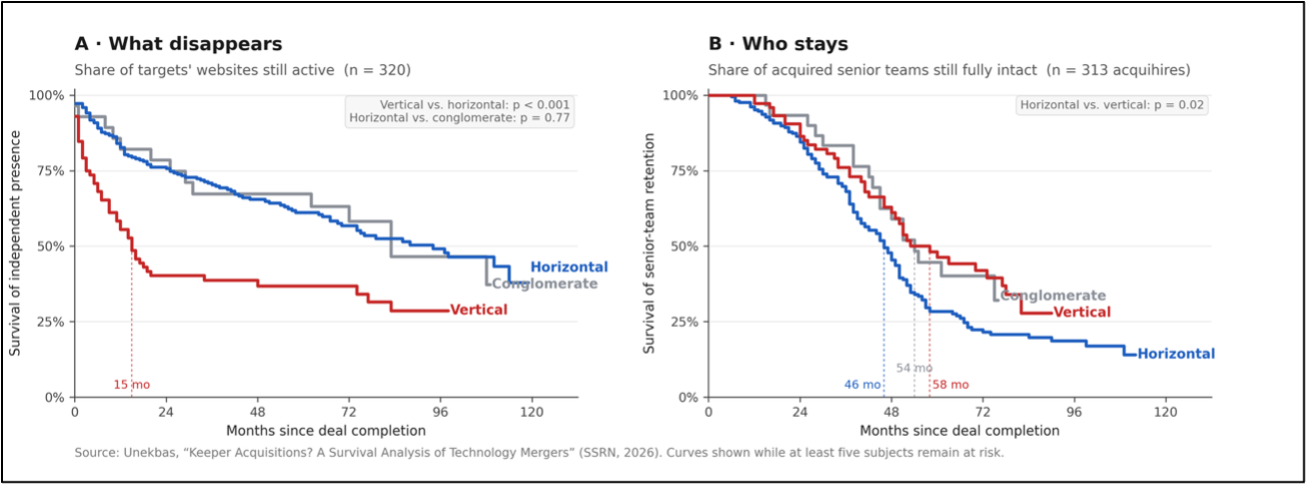
Look at the left panel first. Vertical targets lose their independent presence significantly faster – half are gone within 15 months of deal closing – while the typical horizontal or conglomerate target remains alive for 48 and 69 months. Many continue to function when the window closes in January 2025. Estimating the survival model confirms these results. There, vertical deals carry roughly two-and-a-half times the termination hazard of conglomerate ones, an effect that strengthens when controls are added. Horizontal deals, by contrast, are statistically indistinguishable from conglomerate ones. The targets whose products actually compete with the acquirers’ are not the ones being extinguished fastest. If anything, they linger longer in the market.
Now, let us turn to the right panel. This is the same analysis, but it is run on people rather than websites. We can now see the inversion. Vertical teams are retained longer, with a median employment tenure of 58 months, and 45% of teams remaining fully intact within the acquirer in 2025.[10] Conversely, horizontal teams disintegrate fastest. Their first senior departure arrives at 1.88 times the rate of conglomerate deals and 1.64 times the rate of vertical ones. As in the presence test, these effects also strengthen when I introduce controls and acquirer fixed effects (going from 1.60 in the baseline model to 1.78 with controls and 1.88 with acquirer fixed effects).
The takeaway is the following. Vertical acquisitions shed the target’s form while keeping its substance, and horizontal acquisitions keep the form while shedding the substance. The deals that look most alarming on the presence dimension, such as vertical targets vanishing within 15 months, are the deals where the acquired team is retained for a long time. And the deals that look most benign on the presence dimension are the ones releasing their human capital back into the market.
4. Talent is the deal
Three further findings sharpen the point. First, the disappearance of a target’s website is not accompanied by the shedding of its people. Deals in which the target’s independent presence was terminated show a higher acqui-hire rate (91%) than deals in which it survived (80%). Whatever a dead website signals, it does not signal a discarded team. This is important: a terminated website is compatible with the target’s productive core surviving inside the acquirer.
Second, post-acquisition employment tenures are long. The median acquired senior team stays fully intact for over four years (meaning no departures occur), and the probability that a team survives its first three years inside the acquirer is 71.5%. For comparison, similar studies find that acquirers retain roughly 45% of targets’ overall workforce after three years.[11] This suggests that acquirers are either more interested in senior talent than in the wider workforce, or they are simply better at keeping it.
Third, “golden handcuffs” structure the timing of departures, but they do not explain who stays. A startup acquisition often comes with a retention package for the target’s senior team.[12] These packages include stock options, bonuses, and other perks to induce teams to stay. And they usually last 3–4 years. I find some confirmation for this structure in the data. The departure hazard does peak around the four-year mark where retention packages typically expire, and 41% of observed departures cluster in months 33–51. But “golden handcuffs” do not explain the whole story. Indeed, 40% of departures occur while retention packages are still binding. The hazard rate does not collapse once retention packages expire. And half of all teams outlast the four-year horizon entirely. Most tellingly, there is no reason for retention contracts to vary systematically by competitive overlap (firms do not write longer contracts for horizontal deals). The better interpretation is therefore this: retention packages shape when people leave, but they do not explain whether the acquirer holds onto them.
5. Benign or suspicious?
What explains the findings and, specifically, the inversion? The reading I find most consistent with the data comes from the theory of the firm. Vertical acquisitions are capability acquisitions. Where the acquirer needs an input (like knowledge embedded in a team) that thin markets for frontier technology cannot reliably supply through contracts, it integrates.[13] In the process, it dismantles the target’s independent presence (because that was never the point) and retains the people, because they hold the knowledge, skill, and contacts.[14] Horizontal targets, by contrast, are likely to possess capabilities similar to those the acquirer already holds. Thus, what they can provide to the acquirer is market position, product, or brand. As the team is more likely to be duplicative, it departs sooner. And since market presence is the asset, it stays. Firms, in short, appear to design their acquisition strategies around what they intend to keep.
To be clear, this interpretation is ambiguous from a welfare perspective. Talent retention alone does not make a deal procompetitive. Acquired teams can be poorly assigned or reoriented toward incremental (rather than radical) projects.[15] Depending on context, talent accumulation itself can be problematic too. A growing economic literature models acqui-hires as instruments of “talent hoarding” and monopsony power over specialized labour.[16] The broader concern, that accumulation of innovative capabilities under unitary control may dull creative destruction, is gaining urgency in artificial intelligence markets.[17] The paper’s data cannot adjudicate between the integration story and the concentration story deal by deal. But what it can do is establish where the action is: more in what is kept, and less in what is killed.
6. Implications for merger policy
The paper’s findings have three implications for merger control in general and innovation-centric competition policy in particular. There is also a fourth, more speculative, point.
First, the blind spot may be non-horizontal mergers. Merger control interrogates overlaps in current and future output, which makes it structurally most attentive to horizontal deals. It is comparatively relaxed about non-horizontal transactions.[18] But as I show, in technology markets where intangible assets and human capital dominate physical capital, the deals that accumulate and retain scarce resources are disproportionately the non-horizontal ones. The transactions we treat most benignly are the ones exhibiting distinctive keeper dynamics. This does not mean vertical technology deals should be presumed harmful, but it means they deserve greater attention than they usually receive.
Second, “reverse acqui-hires” are not unprecedented, at least in effect. The arrangements currently drawing scrutiny are keeper acquisitions distilled to their essence: buying substance without form. Large firms often use such “reverse acqui-hires” to hire the team and license the technology while formally buying nothing to escape merger review.[19] My dataset does not include the recent wave of reverse acqui-hires like Microsoft/Inflection or Amazon/Covariant because it only includes outright acquisitions and majority stakes. Even so, the vast majority of the 364 deals in the paper’s sample also escaped merger review. This means that many outright acquisitions accomplished what reverse acqui-hires do, but through conventional means. If the worry is that productive resources can be accumulated outside regulatory scrutiny, the paper shows that worry to be a decade old and hundreds of transactions deep. This, again, suggests that transactions geared toward accumulating productive assets like human capital – vertical acquisitions in my dataset – warrant more attention.
Third, labour mobility is competition policy. Whether the accumulation of human capital is worrying depends on whether the people can leave. In a high-mobility ecosystem, aggressive talent absorption is temporary. People cycle back out, and horizontal deals’ tendency to release teams becomes a feature that rejuvenates the talent pool periodically. In a low-mobility one, absorption comes closer to foreclosure. This makes cartel law a genuine complement to merger control. Enforcement against no-poaching and no-solicitation arrangements keeps the exit channel open and polices the risk that some keeper acquisitions pose. Labour law, and the enforceability of non-compete agreements in particular, may be implicated too.[20]
My final point relates to European competitiveness more generally. The paper’s talent data contains an interesting geographic nuance. Israeli founders depart acquirers far faster than their American counterparts, while EU and UK founders depart around half as fast. In other words, the Israeli talent ecosystem appears roughly three times more mobile than the European one. While these results are only suggestive, their overall direction aligns with ongoing discussions on European competitiveness. Weak talent mobility implies that integrating labour markets is an important part of the Draghi Agenda. In turn, this suggests that fundamental principles of the EU – such as free movement of persons – are compatible with the recent drive toward a more competitive economy.
7. From killing to keeping
For ten years we have asked whether large technology firms acquire startups to eliminate them as competitors. It was an intuitive question, and it spawned a genuine empirical and policy debate. But the data assembled here suggests the more productive question going forward is a different one: what are the cumulative effects of acquisitions on the distribution of innovative capabilities in technology markets?[21] Firms design their acquisition strategies around what they retain. Merger policy should look where the firms are looking. Keeper acquisitions, in short, deserve at least as much attention as killer acquisitions.
Selcukhan Unekbas*
***
* Postdoctoral Researcher, Department of Law, European University Institute; Research Fellow, Haas School of Business, University of California Berkeley & Dynamic Competition Initiative (DCI).
References:
- [1] Colleen Cunningham, Florian Ederer, & Song Ma, ‘Killer Acquisitions’ (2021) 129 Journal of Political Economy 649; Marc Ivaldi, Nicolas Petit, & Selcukhan Unekbas, ‘Killer Acquisitions: Evidence from European Merger Cases’ (2025) 86 Antitrust Law Journal 647.
- [2] Selcukhan Unekbas, ‘Keeper Acquisitions? A Survival Analysis of Technology Mergers’ (Aug. 27, 2026) https://dx.doi.org/10.2139/ssrn.7353959.
- [3] I define “website termination” as the target ceasing to serve a functioning site. This includes instances where the domain is technically active but displays a server error. This choice designates “zombie” websites as inactive and therefore avoids treating formally online but functionally defunct websites as equivalent to operational ones. I treat redirects to the acquirer’s website as termination if the target’s name is no longer mentioned. By contrast, if the redirected website displays the target alongside the acquirer (“Shazam, an Apple Company”), I treat the case as continued public presence. Similar cases were treated as evidence of integration. When designating Booking.com as a “gatekeeper” under the Digital Markets Act, the European Commission noted that Booking integrated a car rental website (RentalCars) into its ecosystem, as evidenced by the RentalCars website appearing as provided “by Booking.com”. See, Case DMA.10019 Booking – Online Intermediation Services [2024], para. 56.
- [4] Beril Boyacioglu, Mahmut Ozdemir, & Samina Karim, ‘Acqui-hires: Redeployment and retention of human capital post-acquisition’ (2024) 45 Strategic Management Journal 205.
- [5] Margaret Levenstein & Valerie Suslow, ‘Breaking Up Is Hard to Do: Determinants of Cartel Duration’ (2011) 54 Journal of Law and Economics 455.
- [6] Apart from a study of hospital mergers, I have not found survival analysis being utilized in a merger paper. See, Martin den Hartog and others, ‘Factors Associated with Hospital Closure and Merger: A Survival Analysis of Dutch Hospitals from 1978 to 2010’ (2013) 26 Health Services Management Research 1.
- [7] Axel Gautier & Joe Lamesch, ‘Mergers in the Digital Economy’ (2021) 54 Information Economics and Policy 100890.
- [8] There could be many explanations for this. However, I generally saw two reasons in the data. The first comes closer to a “failing firm” explanation, whereby the startup in question was already struggling and had to close down its online presence. The second approximates a nascent acquisition instead: the target was so young to begin with that it did not have the time to establish a website before being acquired.
- [9] Mark Lemley & Matthew Wansley, ‘Coopting Disruption’ (2025) 105 Boston University Law Review 457.
- [10] Across the sample, the median team size is 3, mostly reflecting common startup configurations of having a founder (or two co-founders) along with a chief technology officer. Team size does not correlate systematically with competitive overlap: for horizontal and vertical deals, it is 3, while for conglomerate deals it is 4.
- [11] Florian Ederer, Regina Seibel, & Timothy Simcoe, ‘Digital (Killer?) Acquisitions’ (Oct. 6, 2025) https://reginaseibel.github.io/publication/digkiller/digkiller.pdf.
- [12] John Coyle & Gregg Polsky, ‘Acqui-hiring’ (2013) 63 Duke Law Journal 281.
- [13] Richard Langlois, ‘Transaction-cost Economics in Real Time’ (1992) 1 Industrial and Corporate Change 99.
- [14] Armen Alchian, ‘Specificity, Specialization, and Coalitions’ (1984) 140 Journal of Institutional and Theoretical Economics 34.
- [15] Esmee Dijk, Jose Moraga-Gonzalez, & Evgenia Motchenkova, ‘How Do Start-up Acquisitions Affect the Direction of Innovation?’ (2024) 72 The Journal of Industrial Economics 118.
- [16] Jean-Michel Benkert, Igor Letina, & Shuo Liu, ‘Startup acquisitions: Acquihires and talent hoarding’ (2025) 178 European Economic Review 105013.
- [17] Jesus Fernandez-Villaverde, Yang Yu, & Francesco Zanetti, ‘Defensive Hiring and Creative Destruction’ (2025) NBER Working Paper No. 33588.
- [18] Marissa Beck & Fiona Scott Morton, ‘Evaluating the Evidence on Vertical Mergers’ (2021) 59 Review of Industrial Organization 273.
- [19] Benoit Coeure, ‘The competitive dynamics of generative artificial intelligence’ (2025) 13 Journal of Antitrust Enforcement 1.
- [20] Kate Reinmuth & Emma Rockall, ‘Innovation through Inventor Mobility: Evidence from Non-Compete Agreements’ (2026) American Economic Journal: Applied Economics (forthcoming).
- [21] For similar conclusions, see Yassine Lefouili & Leonardo Madio, ‘Mergers and investments: Where do we stand?’ (2026) 105 International Journal of Industrial Organization 103269.